OSHA Compliance & Support | Safety Inspections – Safety Audits | Cost-Effective Safety Consulting

Dust Hazard Analysis (DHA) Services in Houston, TX

Aggie Safety provides NFPA 660-compliant Dust Hazard Analysis (DHA) services for industrial, manufacturing, food processing, and chemical facilities across Houston and the Gulf Coast. Our team is DEKRA-certified in combustible dust hazard analysis and brings more than 30 years of cumulative experience evaluating solids handling systems, identifying ignition sources, and recommending practical explosion protection controls.

A combustible dust explosion does not require a lot of fuel. It requires five conditions:
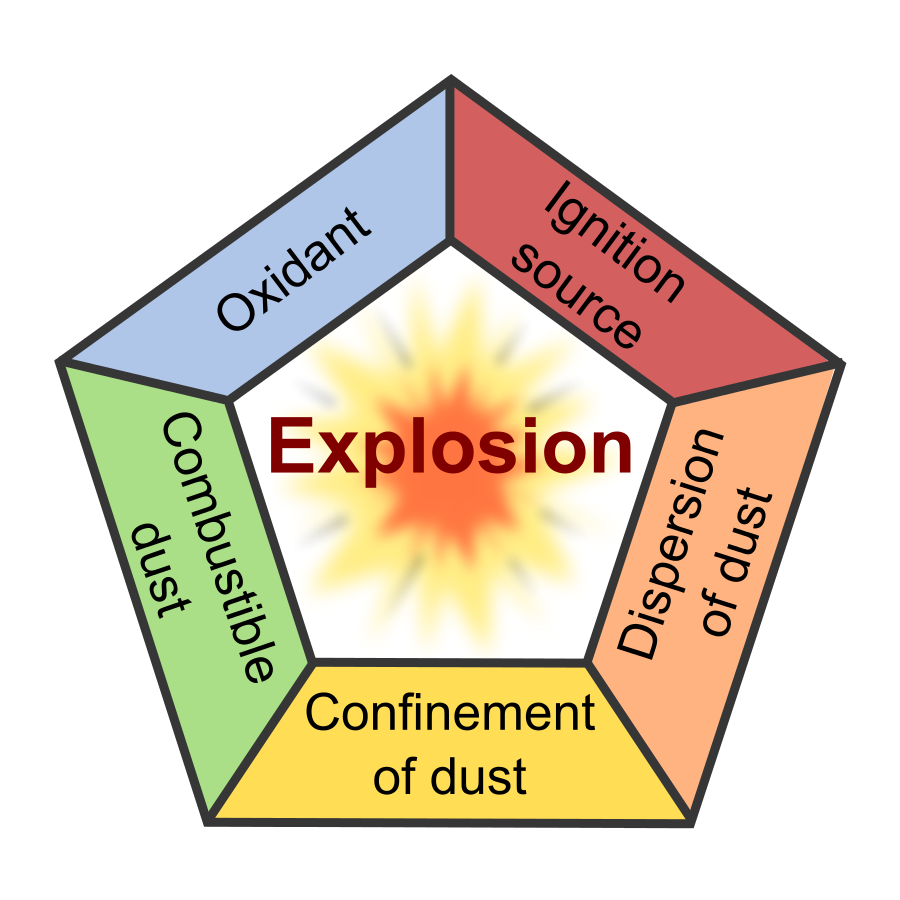
  • combustible dust
  • oxidant (air)
  • dispersion
  • confinement
  • ignition source
dust hazards analysis

When all five come together simultaneously, the dust explosion pentagon, the result can be catastrophic. The February 2008 explosion at Imperial Sugar in Port Wentworth, Georgia, killed 14 workers and injured 38 others, fueled by accumulated sugar dust throughout the packaging building. The June 2013 Williams Olefins explosion in Geismar, Louisiana, killed 2 and injured 167. These incidents are not anomalies; in 2023 alone, combustible dust caused 263 fires, 53 explosions, 94 injuries, and 62 fatalities globally.

A properly conducted DHA identifies those five conditions in your facility before they align.

NFPA 660 Update (Effective December 6, 2024): NFPA 660 -- Standard for Combustible Dusts and Particulate Solids -- consolidates NFPA 652, 61, 484, 654, 655, and 664 into a single unified standard.

If your DHA was conducted under NFPA 652, it remains valid, but your next revalidation must align with NFPA 660 requirements. Aggie Safety is current on NFPA 660 and conducts all new DHAs and revalidations to the updated standard.

Key Takeaways

  • A Dust Hazard Analysis (DHA) is mandatory under NFPA 660 (formerly NFPA 652) for any facility that handles, processes, stores, or generates combustible dust or particulate solids -- and must be revalidated every five years.
  • OSHA enforces DHA requirements under the General Duty Clause and its Combustible Dust National Emphasis Program (NEP, CPL 03-00-008). Non-compliance is a citable violation.
  • Effective December 6, 2024, NFPA 660 replaces NFPA 652 and five commodity-specific standards (NFPA 61, 484, 654, 655, 664) as the governing standard. Aggie Safety conducts all DHAs and revalidations under NFPA 660.
  • A complete DHA covers more than combustibility testing. It includes ignition source assessment, electrostatic hazard evaluation, hazardous area classification, and explosion protection adequacy review.
  • Aggie Safety is DEKRA-certified in combustible dust hazard analysis -- one of few Houston-area consultants holding this credential -- with direct experience in solids handling, pharmaceutical, food processing, wood, metals, and chemical facility types.
  • Both prescriptive (checklist-based, faster) and performance-based (risk-based, more flexible) DHA approaches are available. Aggie Safety recommends the right approach for your facility type, risk profile, and compliance timeline.

Why a Dust Hazard Analysis Is Required and What Happens Without One

Combustible dust is one of the most underestimated hazards in industrial facilities. Materials that appear inert -- sugar, grain, wood flour, aluminum powder, pharmaceutical API, plastic resin -- can form explosive clouds when suspended in air at sufficient concentrations.

The regulatory framework is clear. NFPA 660 (and its predecessor, NFPA 652) requires facilities that handle or generate combustible particulate solids to complete a DHA. OSHA enforces this requirement under:

  • The General Duty Clause (Section 5(a)(1)) -- requiring employers to eliminate recognized hazards likely to cause death or serious physical harm
  • OSHA Combustible Dust National Emphasis Program (NEP) -- CPL 03-00-008 -- an active enforcement program targeting facilities with combustible dust hazards
  • OSHA 29 CFR 1910 Subpart H -- General Industry standards addressing flammable and combustible materials

When OSHA inspects a facility under the NEP and finds no DHA, or a DHA that has not been revalidated within five years, the citation outcome is predictable. Penalties for willful violations now exceed $165,000 per instance. More importantly, an uncompleted DHA is the documented evidence that a hazard was recognized but not addressed -- which matters directly in liability determinations after an incident.

Local fire codes in the Houston area -- enforced by the City of Houston Fire Marshal, Harris County Fire Code, and Texas State Fire Marshal Office -- adopt NFPA standards by reference. Building permits for facilities handling combustible dust may require a completed DHA as part of the submission package.

What Aggie Safety’s Dust Hazard Analysis Covers

A DHA is not a single checklist. It is a structured study that evaluates every aspect of how combustible dust is generated, handled, and controlled in your facility. Aggie Safety's DHA scope covers six interconnected areas:

1. Combustibility Screening and Dust Properties

Before any analysis can proceed, the question of whether your dust is combustible must be answered with data, not assumption. Aggie Safety helps clients obtain representative dust samples and coordinate testing through accredited laboratories to determine:

  • Kst (deflagration index) -- the rate of pressure rise in an explosion; determines explosion severity class (St-1, St-2, St-3)
  • Pmax (maximum explosion pressure) -- the peak pressure achieved in a contained explosion
  • Minimum Ignition Energy (MIE) -- the minimum spark energy that can ignite a dust cloud
  • Minimum Ignition Temperature (MIT) -- for both dust cloud and dust layer
  • Minimum Explosible Concentration (MEC) -- the minimum airborne dust concentration that can propagate a flame
  • Limiting Oxygen Concentration (LOC) -- the maximum oxygen level at which an explosion cannot propagate (used for inerting design)
  • Powder resistivity -- critical for electrostatic hazard evaluation
  • Particle size distribution -- affects dispersibility and explosion severity

For facilities already holding test data, Aggie Safety reviews existing certificates for applicability to current process conditions and identifies whether retesting is needed due to process changes.

OSHA compliance services Houston

2. Equipment and Process Area Survey

Aggie Safety conducts a structured walk-through of your facility to inventory all equipment and process areas where combustible dust is generated, handled, conveyed, collected, or stored. This includes:

Category Equipment Evaluated
Storage Silos, bins, hoppers, bunkers, portable containers, FIBCs (bulk bags), day tanks
Conveying Systems Belt conveyors, screw conveyors (augers), pneumatic conveyors, bucket elevators, vibratory conveyors, drag chains
Size Reduction / Mixing Jaw crushers, ball mills, hammer mills, screens, sifters, grinders, blenders, magnetic separators
Dust Collection Cyclones, baghouses, cartridge filters, dust collectors — including inlet and outlet locations and ductwork routing
Processing / Transfer Dryers, spray systems, packaging lines, filling stations, transfer points, weigh hoppers
Utilities HVAC systems, compressed air lines, vacuum systems in areas handling combustible dust

3. Ignition Source Assessment

Identifying combustible dust alone is not enough. A DHA must evaluate whether credible ignition sources exist -- and whether controls are adequate to prevent ignition from reaching a combustible atmosphere. Aggie Safety's ignition source assessment covers all thirteen ignition source categories defined in EN 1127-1, applied in the context of NFPA 660 requirements:

  • Hot surfaces -- equipment surfaces that exceed dust layer or cloud ignition temperatures under normal or upset conditions
  • Flames and hot gases -- direct firing, flue gas contact, pilot lights, hot air dryers
  • Mechanical sparks -- grinding, cutting, bearing failures, tramp metal ingestion into mills or conveyors
  • Electrical equipment -- non-rated electrical equipment in classified areas; damaged or improper wiring
  • Stray electric currents and cathodic corrosion protection
  • Static electricity -- the most frequently underestimated ignition source in powder handling; covered in depth under Section 4 below
  • Lightning -- for outdoor or partially outdoor facilities
  • Electromagnetic fields (RF sources, radar)
  • Ionizing radiation
  • Ultrasound
  • Adiabatic compression and shock waves -- relevant to pneumatic conveying systems
  • Exothermic reactions and self-heating -- particularly for organic dusts prone to spontaneous ignition in storage
  • Smoldering material and embers -- especially in dryer systems and dust collectors

The ignition source assessment produces a documented matrix linking each ignition source to each process area or piece of equipment, with existing controls evaluated and gaps identified. This is a direct input to the DHA risk ranking and recommendation register.

4. Electrostatic Hazard Assessment

Static electricity is the ignition source most commonly missed in facility self-assessments -- and one of the most likely to cause a dust explosion in powder handling operations. An electrostatic discharge (ESD) can occur with energy as low as 1-3 mJ for sensitive dusts, well below the threshold of human perception.

An electrostatic ignition hazard requires four conditions to occur simultaneously:

  • A flammable or explosible atmosphere (combustible dust cloud or hybrid mixture)
  • A process that generates static charge (contact and separation of dissimilar materials, flow through pipes, pneumatic conveying)
  • Charge accumulation on an isolated conductive object or insulating surface
  • A discharge energetic enough to ignite the atmosphere

Aggie Safety evaluates electrostatic hazards as part of the DHA using the following approach:

  • Review of all conductive plant components (vessels, pipes, containers, FIBC bags, rotary valves, scoops) for proper grounding and bonding -- the fundamental control for ESD on conductors
  • Evaluation of resistance to ground measurements; any reading above 10 ohms for conductive equipment signals a grounding deficiency requiring correction
  • Assessment of insulating materials in the process path -- conveyor belts, plastic liners, polymer bags, plastic ductwork -- for potential charge accumulation
  • Evaluation of FIBC (bulk bag) type -- Type A, B, C, or D -- against the dust MIE to confirm appropriate bag selection for the hazard level
  • Review of personnel grounding practices, including footwear, gloves, and wrist straps in powder transfer operations
  • Evaluation of process conditions that generate high charge: pneumatic conveying, sieving, pouring, mixing, and blending of fine powders
  • Assessment of inerting adequacy where electrostatic controls alone are insufficient for high-sensitivity dusts (low MIE)

The electrostatic hazard assessment produces specific, actionable findings -- not generic recommendations. Where grounding deficiencies are identified, Aggie Safety specifies the corrective path. Where insulating materials present accumulation risks, we evaluate whether the material can be replaced, coated, or ionized, and whether the surrounding explosion protection is adequate to tolerate a discharge event.

5. Hazardous Area Classification

NFPA 660 (consistent with prior standards) requires facilities to classify areas where combustible dust may be present into hazard zones, which determines the electrical equipment rating required in those areas. This is called Hazardous Area Classification (HAC) or electrical area classification for dust.

The US classification system (NFPA 70 / NEC) defines:

  • Class II, Division 1: Combustible dust is present in the air in quantities sufficient to produce explosive or ignitible mixtures during normal operations, or where failure of equipment could produce simultaneous ignition and cloud formation
  • Class II, Division 2: Combustible dust is not normally present in ignitible concentrations but could become so due to abnormal operations

The IEC zone system (used for international facilities and increasingly adopted in US practice) defines Zone 20, 21, and 22 for progressive likelihood of explosible dust atmosphere.

Aggie Safety produces area classification drawings as part of the DHA deliverable, identifying zones throughout the facility and cross-referencing against the electrical equipment installed in each zone. Where unrated or inadequately rated electrical equipment is present in classified areas -- a very common finding in facilities that have expanded or modified equipment without updating their HAC -- Aggie Safety documents the deficiency and provides prioritized corrective recommendations. This section of the DHA directly connects to our Explosion Protection and Electrical Classifications service.

6. Explosion Protection Adequacy Review

Identifying hazards is only part of the DHA. The study must also evaluate whether the explosion protection measures in place -- and those that need to be added -- are adequate for the hazard level. Aggie Safety evaluates the following control hierarchy:

Inherent Safety: Elimination of combustible dust through material substitution or wet processing where feasible. Least common in practice but highest effectiveness.

Inerting: Reducing oxygen concentration below the Limiting Oxygen Concentration (LOC) using nitrogen or CO2. Required for very sensitive dusts (low MIE, high Kst) where ignition sources cannot be reliably excluded. Aggie Safety evaluates LOC-based inerting designs per NFPA 69.

Explosion Venting: Pressure relief panels or rupture disks that vent explosion pressure to a safe location. Sized per NFPA 68 based on Kst, Pmax, and enclosure volume. Aggie Safety reviews existing vent sizing calculations and identifies inadequate or missing vents.

Explosion Suppression: Detection and chemical suppression systems that abort a developing explosion before pressure builds to a damaging level. Aggie Safety evaluates system design adequacy for equipment where venting to atmosphere is not possible.

Explosion Isolation: Prevents flame and pressure propagation between connected equipment through the process -- bucket elevators, ductwork, pipe runs. Methods include chemical isolation barriers, fast-acting valves, and passive isolation. Vendor reference: Fike, Rembe, and similar. Aggie Safety evaluates isolation adequacy for connected equipment trains.

Pressure Containment: Designing equipment to contain a full dust explosion without rupture. Limited to small volumes and high-Pmax equipment; not practical for large process enclosures.

Housekeeping and Administrative Controls: Documented housekeeping procedures, frequency, and methods for preventing secondary dust accumulation. NFPA 660 is explicit: cleaning methods must not generate a dust cloud. Compressed air blowdown and ordinary vacuum cleaners are prohibited in classified areas. Aggie Safety reviews housekeeping programs and identifies gaps.

The explosion protection review produces a recommendation register with findings ranked by risk level, estimated implementation cost category, and suggested completion priority -- giving facility management a structured basis for budgeting corrective actions.

Which NFPA Standard Applies to Your Facility

Under NFPA 660 (effective December 6, 2024), the industry-specific commodity standards have been consolidated. Chapters 21-25 of NFPA 660 now contain the requirements previously found in the separate commodity standards. The table below maps facility types to the applicable NFPA 660 chapter and legacy standard reference for context.
Industry / Material NFPA 660 Chapter Legacy Standard Common Dust Types
All Covered Facilities (General Requirements) Chapters 1-10 NFPA 652 All combustible particulate solids
Agricultural and Food Processing Chapter 21 NFPA 61 Grain, flour, sugar, starch, powdered milk, cocoa, coffee
Combustible Metals Chapter 22 NFPA 484 Aluminum, magnesium, titanium, zirconium, lithium
General Manufacturing / Chemical / Pharma Chapter 23 NFPA 654 Plastic resins, rubber, API pharmaceuticals, pesticides, dyes
Sulfur Processing Chapter 24 NFPA 655 Elemental sulfur
Wood Processing Chapter 25 NFPA 664 Wood flour, sawdust, sanding dust, MDF dust
If your facility handles more than one material type -- for example, a chemical plant that also processes organic solids -- NFPA 660 Chapters 1-10 provide the general requirements and Chapters 21-25 provide the commodity-specific additions. Aggie Safety evaluates which sections apply to your specific process and documents the basis in the DHA report.

Prescriptive vs. Performance-Based DHA: Choosing the Right Approach

NFPA 660 supports two DHA approaches. Aggie Safety selects the right one for your facility based on process complexity, available test data, and compliance timeline.
Prescriptive (Checklist-Based) Performance-Based (Risk-Based)
How it works Evaluates facility against the specific requirements of the applicable NFPA 660 chapter. Gaps are identified as deviations from prescriptive code requirements. Quantifies the risk of each identified scenario using ignition likelihood and consequence severity. Safeguard adequacy is judged against a defined risk tolerance criterion.
Best for Facilities with well-defined process conditions, complete dust test data, and equipment/operations that align closely with NFPA prescriptive requirements Facilities where prescriptive compliance would require disproportionately costly controls, or where a risk-based argument can justify a more targeted safeguard set
Advantage Faster, lower cost, directly defensible against code requirements, clear pass/fail format Can justify lower-cost solutions where risk analysis shows controls are adequate; more flexible for non-standard operations
Output Findings matrix with code reference, gap description, and recommended corrective action Risk ranking of scenarios, safeguard adequacy determination, and targeted corrective action register
Aggie Safety note Recommended for most initial DHAs and five-year revalidations where the process has not changed significantly Used when a facility's operation does not fit prescriptive mold, or when initial prescriptive review identifies controls that are infeasible or disproportionate to risk

NFPA 660: What Changed and What Your Facility Needs to Do

NFPA 660 became effective December 6, 2024. This is the most significant regulatory change in combustible dust safety in over a decade. Here is what changed and what it means for facilities that have an existing DHA under NFPA 652.
What NFPA 660 consolidates

Six separate NFPA standards -- 652 (fundamentals), 61 (ag/food), 484 (metals), 654 (general manufacturing), 655 (sulfur), and 664 (wood) -- are now unified under NFPA 660. This eliminates inconsistencies between the standards and creates a single compliance framework.

What changed for DHAs
  • Clearer qualification requirements for the DHA team leader -- must have documented experience in conducting DHAs and knowledge of combustible dust hazards specific to the materials and process type being evaluated
  • Reinforced five-year revalidation cycle -- NFPA 660 maintains the requirement from NFPA 652 but adds clarity that revalidation is not just a review of prior findings; it must confirm the DHA reflects current process conditions
  • Earlier revalidation triggers -- a DHA must be revalidated when process changes, equipment changes, new materials, or incidents indicate that the current DHA may no longer reflect actual hazards
  • Expanded housekeeping requirements -- cleaning methods must not create a dust cloud; this explicitly prohibits compressed air blowdown and standard shop vacuums in dust-classified areas
  • Industry-specific updates -- expanded guidance for metals (aluminum, magnesium), food and agricultural facilities, and wood processing operations
What facilities should do now
  • If your DHA was completed before December 2024 under NFPA 652: it remains valid until your next revalidation date. Your next revalidation should be conducted to NFPA 660. Aggie Safety can conduct that revalidation.
  • If your initial DHA has never been completed: NFPA 660 is the current applicable standard. Aggie Safety conducts initial DHAs under NFPA 660.
  • If you have had process changes, new materials, or incidents since your last DHA: revalidation is required regardless of the five-year cycle. Contact Aggie Safety to scope the revalidation.

How Aggie Safety Conducts a Dust Hazard Analysis

Step 1
Free Scoping Call

We discuss your facility type, materials handled, process description, existing DHA status, and any known concerns or incidents. We confirm whether you need an initial DHA, a five-year revalidation, or a targeted revalidation triggered by process change. We identify which NFPA 660 chapters apply and estimate the study scope and timeline.

1
2
Step 2
Document and Data Review

Before the site visit, Aggie Safety reviews your Process Safety Information package: facility layout drawings, equipment list, P&IDs or process flow diagrams, existing dust test data, prior DHA reports (if applicable), and electrical area classification drawings. Gaps in documentation are identified before the study begins — missing test data or incomplete drawings reduce the quality of DHA findings and should be resolved in advance.

Step 3
On-Site Facility Walk-Through

Aggie Safety conducts a structured on-site inspection with your operations, maintenance, and engineering team. The walk-through covers all areas where combustible dust is generated, handled, conveyed, processed, or collected. We document equipment, identify dust accumulation locations, assess housekeeping practices, evaluate ignition source controls, and inspect explosion protection equipment.

3
4
Step 4
Ignition Source and Electrostatic Evaluation

A dedicated evaluation of ignition sources and electrostatic hazards is conducted during or following the walk-through. This includes grounding and bonding inspections, FIBC type verification, review of electrical equipment ratings against area classifications, and identification of process conditions that generate significant static charge.

Step 5
Analysis and Risk Ranking

Findings from the walk-through, document review, and specialized evaluations are compiled and analyzed. Each identified hazard is assessed for likelihood and consequence severity. Recommendations are developed and ranked by priority — immediate actions (life-safety concerns), short-term actions (significant risk reduction), and longer-term program improvements.

5
6
Step 6
Draft Report and Client Review

You receive a draft DHA report for review. The report includes: facility and process description, dust properties and data review, equipment inventory, identified hazards and existing safeguards, findings and gaps, a prioritized recommendation register with code references, and NFPA 660 compliance status. We revise based on your feedback.

Step 7
Final Report and Ongoing Support

The final DHA report is issued. Aggie Safety can provide ongoing support for recommendation implementation, including explosion protection design review, housekeeping program development, electrical classification drawing updates, and follow-up inspections. We also track your next revalidation date and can be engaged for the five-year review.

7

Why Houston Facilities Choose Aggie Safety for
Combustible Dust Hazard Analysis

DEKRA-certified with 30-plus years of cumulative experience

Aggie Safety is DEKRA-certified in combustible dust hazard analysis. DEKRA certification is the standard credentialing framework for DHA professionals and is recognized by OSHA and fire marshals. Our team brings more than 30 years of cumulative experience evaluating solids handling systems across chemical, pharmaceutical, food processing, metals, and wood processing industries. This is not generic safety consulting -- it is specialized expertise that comes from having evaluated hundreds of dust handling systems.

Houston-based, Gulf Coast-experienced

Our consultants are based in Houston and work regularly with the industrial facilities that define this region: chemical plants, refineries, grain handling terminals, food manufacturers, and specialty chemical producers. We understand the Harris County Fire Code, the Texas State Fire Marshal's requirements, and the specific enforcement patterns of the Houston area OSHA offices. On-site support is available throughout Greater Houston, including Pasadena, Baytown, Deer Park, Texas City, Freeport, La Porte, and surrounding areas.

Full-scope: DHA through explosion protection

Most DHA consultants deliver findings and leave. Aggie Safety supports the full lifecycle: initial DHA, ignition source and electrostatic assessments, hazardous area classification, explosion protection design review, housekeeping program development, and five-year revalidations. You do not need to re-educate a new consultant at each stage. Our team already knows your facility.

Integrated with PSM compliance

For facilities covered under OSHA PSM or EPA RMP, the DHA is not a standalone document -- it is a required component of the Process Safety Information element (29 CFR 1910.119(d)). Aggie Safety's team holds the full PSM/RMP picture, so DHA findings are integrated into your broader compliance program rather than issued as a disconnected report. See our PSM/RMP Support page for how the two services connect.

Practical recommendations, not theoretical ones

A DHA that produces 80 findings with no prioritization or cost context is not useful to a facility manager. Aggie Safety's DHA reports rank findings by risk level, flag life-safety concerns for immediate action, and provide guidance on implementation sequence and relative cost. The goal is a document your operations team can actually execute against -- not a report that goes into a binder.

Industries Aggie Safety Serves for DHA

Combustible dust hazards exist across far more industries than most facility managers realize. Any solid material that is finely divided can be combustible -- the question is the degree of explosibility and the likelihood of forming a cloud. Aggie Safety has conducted DHAs for facilities across the following industry types:
Industry Common Combustible Dusts Typical DHA Focus Areas
Food & Agriculture Sugar, flour, starch, grain, powdered milk, cocoa, spices, coffee Dust collectors, bucket elevators, silo venting, packaging lines, dryers
Chemical Manufacturing Organic chemical intermediates, pigments, dyes, resins, sulfur Reactors, dryers, conveyors, dust collection, inerting systems
Pharmaceutical API powders, excipients, spray-dried materials Highly sensitive dusts (low MIE); containment, electrostatic controls, inerting
Metals Processing Aluminum, magnesium, titanium, iron, zinc Extremely reactive dusts; grinding, machining, polishing, wet suppression vs. dry systems
Wood Products Sawdust, wood flour, MDF dust, sanding dust Dust collectors, pneumatic conveying, silo storage, wood dryers
Plastics & Rubber Polyethylene, polypropylene, nylon, ABS, rubber dust Compounding, conveying, blending, packaging
Petrochem / Specialty Chemical Carbon black, catalyst powders, polymer pellets Reactor feed systems, catalyst handling, pneumatic dense-phase conveying
OSHA compliance services Houston

Referenced Incidents and CSB Resources

The Chemical Safety Board (CSB) has documented numerous catastrophic combustible dust incidents. Aggie Safety references the following in DHA facilitation as real-world anchors for why each element of the study matters:

  • Imperial Sugar Refinery, Port Wentworth, Georgia (February 7, 2008): 14 killed, 38 injured. Accumulated sugar dust throughout the packaging building. CSB video: "Inferno: Dust Explosion at Imperial Sugar" -- aggiesafety.com recommends this for employee training.
  • Williams Olefins Plant, Geismar, Louisiana (June 2013): 2 killed, 167 injured. Closed path to pressure relief valve created overpressure conditions. While a gas explosion, this incident illustrates the common root cause in process safety: a safeguard that was present but not functional.
  • West Fertilizer Company, West, Texas (April 2013): 15 killed, 160+ injured. Relevant to Texas-based facility operators as a reminder that regulatory gaps at the local level do not reduce the consequence severity of a major incident.

CSB investigation reports and videos are available at csb.gov and are referenced in Aggie Safety DHA reports where the lessons are relevant to the specific facility type being evaluated.

Frequently Asked questions

Answers to the most common questions about OSHA compliance, safety training, and working with Aggie Safety.
What is a Dust Hazard Analysis (DHA)?
A Dust Hazard Analysis is a systematic study to identify, evaluate, and document potential fire, flash fire, and explosion hazards associated with combustible dust or particulate solids in a facility. It covers whether dusts are combustible, where explosible concentrations can form, what ignition sources are present, whether existing safeguards are adequate, and what additional controls are needed. Under NFPA 660 (effective December 2024), a DHA is mandatory for any facility that handles, processes, generates, or stores combustible particulate solids.
Is a DHA required by OSHA?
Yes. OSHA requires combustible dust hazard management under the General Duty Clause (Section 5(a)(1)) and enforces it through its Combustible Dust National Emphasis Program (NEP, CPL 03-00-008). NFPA 660 -- the standard that requires the DHA -- is a recognized good engineering practice (RAGAGEP) under OSHA, meaning that OSHA can cite a facility for not following it even though NFPA standards are not regulations themselves. Many state and local fire codes also adopt NFPA standards by reference, making DHA compliance directly enforceable under fire codes as well.
What is NFPA 660 and how does it replace NFPA 652?
NFPA 660: Standard for Combustible Dusts and Particulate Solids became effective December 6, 2024. It consolidates NFPA 652 (general requirements) and five commodity-specific standards -- NFPA 61 (agriculture/food), NFPA 484 (metals), NFPA 654 (general manufacturing), NFPA 655 (sulfur), and NFPA 664 (wood) -- into one unified document. Facilities with existing DHAs conducted under NFPA 652 do not need to immediately redo the study; their DHA remains valid until the next revalidation cycle. However, the next revalidation must be conducted under NFPA 660. Aggie Safety conducts all new DHAs and revalidations under NFPA 660.
How often does a DHA need to be updated?
NFPA 660 requires DHA revalidation every five years from the date of the previous DHA or revalidation. Revalidation is also required earlier than the five-year cycle when: (1) a process change, equipment change, or new material is introduced that could change the dust hazard profile; (2) an incident or near-miss involving combustible dust occurs; or (3) OSHA or the fire marshal identifies a deficiency during an inspection. Aggie Safety tracks revalidation dates for clients and can provide advance notice when a revalidation is approaching.
What is the dust explosion pentagon?
The dust explosion pentagon describes the five conditions that must be present simultaneously for a combustible dust explosion to occur: (1) combustible dust, (2) an oxidant (typically oxygen in air), (3) dispersion of dust in air at a sufficient concentration, (4) confinement of the dust cloud, and (5) an ignition source. A DHA evaluates each element of the pentagon across your facility. Effective explosion prevention targets eliminating or controlling one or more elements -- typically by preventing dispersion (good housekeeping, enclosed equipment), excluding ignition sources, or reducing oxygen concentration through inerting.
What is the difference between a prescriptive and performance-based DHA?
A prescriptive DHA evaluates your facility against the specific requirements in the applicable NFPA 660 chapter -- each requirement is either met or not met, and gaps are documented as findings. A performance-based DHA quantifies the risk of specific scenarios using ignition likelihood and consequence severity, then evaluates whether existing safeguards bring that risk below a defined target. Prescriptive DHAs are faster and directly defensible against code requirements. Performance-based DHAs are more flexible and can justify alternative controls where prescriptive requirements would be disproportionately costly. Aggie Safety recommends the approach that fits your facility's complexity, cost constraints, and regulatory context.
What is an electrostatic hazard assessment and why is it part of a DHA?
An electrostatic hazard assessment evaluates whether static electricity buildup in your process represents a credible ignition source for combustible dust. Static charge is generated whenever dissimilar materials come into contact and separate -- which happens continuously in pneumatic conveying, sieving, pouring, and blending of powders. If that charge accumulates on an isolated conductor or insulating surface and discharges as a spark, it can ignite a dust cloud. Aggie Safety evaluates grounding and bonding of all conductive equipment, FIBC bag type against dust MIE, personnel grounding practices, and the presence of insulating materials in the process path. This assessment is required by NFPA 660 as part of the ignition source evaluation and is one of the most technically specialized components of a complete DHA.
What is hazardous area classification for combustible dust?
Hazardous area classification (HAC) identifies zones within your facility where combustible dust may be present in ignitable concentrations, and assigns electrical equipment ratings requirements for those zones. Under NFPA 70 (National Electrical Code), areas with combustible dust are classified as Class II, Division 1 (dust present during normal operations) or Class II, Division 2 (dust present only during abnormal operations). Electrical equipment installed in these areas must be rated for the dust type and division. A DHA produces area classification drawings that identify classified zones throughout the facility. Where inadequately rated equipment exists in classified areas -- a frequent finding -- Aggie Safety documents the deficiency and provides prioritized corrective recommendations.
How long does a DHA take and what does it cost?
Timeline and cost depend on facility size, process complexity, number of dust types handled, availability of existing documentation, and whether the engagement is an initial DHA, a five-year revalidation, or a targeted revalidation for a specific process change. A small single-product facility may complete a DHA in two to three days on-site with a report issued within two weeks. A large multi-product chemical plant may require a multi-week study with a more extensive deliverable package. Aggie Safety provides a fixed-scope proposal after the free scoping call, so you know the cost and timeline before the engagement begins. Contact us at (713) 613-2830 to discuss your facility.
Can Aggie Safety conduct a DHA for a facility that has already had one done?
Yes. Aggie Safety regularly conducts five-year revalidations of existing DHAs, regardless of who conducted the original study. We review the prior DHA report, confirm recommendation closure status, evaluate process changes since the last study, and update the DHA to reflect current conditions and NFPA 660 requirements. Where the prior DHA had methodology gaps or incomplete scope -- a common finding when the original study was conducted by a less specialized consultant -- we identify and address those gaps as part of the revalidation.
Dust Hazard Analysis

Schedule Your Dust Hazard Analysis in Houston

Whether you need an initial DHA, a five-year NFPA 660 revalidation, an electrostatic hazard assessment, or a targeted review following a process change, Aggie Safety can scope and deliver the study. Call (713) 613-2830 or fill out the form below and we will follow up promptly.
Aggie Safety serves industrial and manufacturing facilities throughout Greater Houston, including Pasadena, Baytown, Deer Park, Texas City, Freeport, La Porte, and the Gulf Coast industrial corridor.
Aggie Safety Logo
Your safety partner in OSHA compliance and workforce protection.
  • 6001 Savoy Dr Suite #201B, Houston, TX 77036, USA
  • 8AM – 5PM Monday – Friday
© 2026 Aggie Safety | All Rights Reserved.