
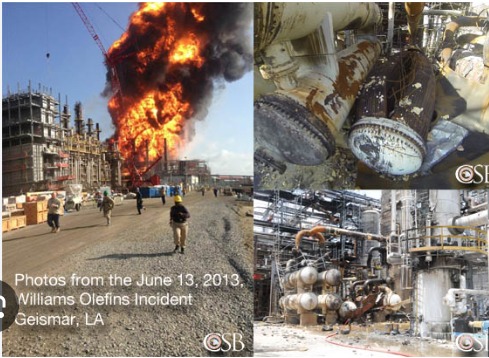
Pressure Relief Systems are the last line of defense in plants handling hazardous materials at elevated pressures. One of the recent accidents in the United States is mentioned in the Chemical Safety Board video on the Williams Olefin Plant at Geismar:
Williams Olefins Plant Explosion and Fire | CSB
Aggie Safety experts provide pressure relief system design and validation support for both new and existing systems. Aggie Safety has ~30 years of cumulative experience in this specialized work, which requires thermodynamic knowledge of the fluid being handled as well as mechanical expertise in how pressure relief systems operate.
| Standards | Scope | Aggie Safety Support |
|---|---|---|
| ASME Section VIII Div 1 | Rules for design, fabrication, inspection, testing, and certification of pressure vessels (standard design-by-rule approach). | Support with code applicability, PSV sizing inputs, documentation review, and compliance gaps for vessel packages. |
| ASME Section VIII Div 2 | Alternative rules for pressure vessels (design-by-analysis, more rigorous requirements). | Review design basis, required analyses, inspection/testing requirements, and traceability expectations for compliance. |
| ASME Section VIII Div 3 | Rules for high-pressure vessels (special design/fabrication controls). | Confirm code selection, relief philosophy implications, documentation completeness, and interface with OEM/authorized inspector requirements. |
| ASME B31.1 | Power piping (design, materials, fabrication, examination, testing, and operation/maintenance). | Support with piping code boundary, relief device tie-ins, test requirements, and hazard review inputs for power systems. |
| ASME B31.3 | Process piping (design, materials, fabrication, inspection, testing, and operation). | Assist with code applicability, MOC/PSM alignment, overpressure scenario inputs, and audit-ready documentation for process piping. |
| API 520 | Sizing, selection, and installation of pressure-relieving devices (Part I/II/III). | Perform/validate PSV sizing basis, installation checks, set pressure accumulation/overpressure criteria review, and calculation documentation. |
| API 521 | Pressure-relieving and depressuring systems (relief scenarios, flare/vent design considerations). | Facilitate relief system design basis, scenario development, flare/vent system screening, and documentation for PHA/LOPA support. |
| API 526 | Flanged steel pressure-relief valves (standard orifice sizes, dimensions). | Verify valve selection/orifice basis, datasheets, and mechanical fit-up assumptions for procurement and installation. |
| API 527 | Seat tightness of pressure relief valves (test and acceptance criteria). | Support test program requirements, acceptance criteria interpretation, and documentation review for repairs/recertification. |
| API 537 | Flare details for general refinery and petrochemical service. | Provide flare system review support (design basis alignment, operability/safety considerations) and interface with relief design per API 521. |
| API 576 | Inspection of pressure-relieving devices (maintenance/inspection practices). | Assist with inspection intervals, inspection checklist development, deficiency tracking, and program audits. |
| API 620 | Design and construction of large, welded, low-pressure storage tanks. | Support with tank overpressure protection basis, venting philosophy, and alignment with API 2000 requirements. |
| API 650 | Welded tanks for oil storage (atmospheric/near-atmospheric service). | Assist with tank venting/relief basis inputs, inspection/maintenance considerations, and documentation review for compliance. |
| API 2000 | Venting atmospheric and low-pressure storage tanks (normal and emergency venting). | Perform/validate vent sizing basis (inbreathing/outbreathing, emergency cases), setpoints, and documentation for audits/PHAs. |
| CSA S-1.1 | Relief valve standard — scope to be confirmed for your application and jurisdiction. | Confirm applicability to site/jurisdiction, align requirements with internal standards, and integrate into relief device specification/package review. |
| CSA S-1.2 | Relief valve standard — scope to be confirmed for your application and jurisdiction. | Confirm applicability to site/jurisdiction, support documentation/inspection expectations, and ensure alignment with relief philosophy. |
| CSA S-1.3 | Relief valve standard — scope to be confirmed for your application and jurisdiction. | Confirm applicability to site/jurisdiction, verify testing/maintenance expectations, and incorporate into audit/PSM documentation. |
Pressure Relief Systems are the last line of defense in plants handling hazardous materials at elevated pressures. One of the recent accidents in the United States is mentioned in the Chemical Safety Board video on the Williams Olefin Plant at Geismar:
Williams Olefins Plant Explosion and Fire | CSB
Aggie Safety experts provide pressure relief system design and validation support for both new and existing systems. Aggie Safety has ~30 years of cumulative experience in this specialized work, which requires thermodynamic knowledge of the fluid being handled as well as mechanical expertise in how pressure relief systems operate. Our pressure relief system design work follows established industry codes/standards, including:
| Standards | Scope | Aggie Safety Support |
|---|---|---|
| ASME Section VIII Div 1 | Rules for design, fabrication, inspection, testing, and certification of pressure vessels (standard design-by-rule approach). | Support with code applicability, PSV sizing inputs, documentation review, and compliance gaps for vessel packages. |
| ASME Section VIII Div 2 | Alternative rules for pressure vessels (design-by-analysis, more rigorous requirements). | Review design basis, required analyses, inspection/testing requirements, and traceability expectations for compliance. |
| ASME Section VIII Div 3 | Rules for high-pressure vessels (special design/fabrication controls). | Confirm code selection, relief philosophy implications, documentation completeness, and interface with OEM/authorized inspector requirements. |
| ASME B31.1 | Power piping (design, materials, fabrication, examination, testing, and operation/maintenance). | Support with piping code boundary, relief device tie-ins, test requirements, and hazard review inputs for power systems. |
| ASME B31.3 | Process piping (design, materials, fabrication, inspection, testing, and operation). | Assist with code applicability, MOC/PSM alignment, overpressure scenario inputs, and audit-ready documentation for process piping. |
| API 520 | Sizing, selection, and installation of pressure-relieving devices (Part I/II/III). | Perform/validate PSV sizing basis, installation checks, set pressure accumulation/overpressure criteria review, and calculation documentation. |
| API 521 | Pressure-relieving and depressuring systems (relief scenarios, flare/vent design considerations). | Facilitate relief system design basis, scenario development, flare/vent system screening, and documentation for PHA/LOPA support. |
| API 526 | Flanged steel pressure-relief valves (standard orifice sizes, dimensions). | Verify valve selection/orifice basis, datasheets, and mechanical fit-up assumptions for procurement and installation. |
| API 527 | Seat tightness of pressure relief valves (test and acceptance criteria). | Support test program requirements, acceptance criteria interpretation, and documentation review for repairs/recertification. |
| API 537 | Flare details for general refinery and petrochemical service. | Provide flare system review support (design basis alignment, operability/safety considerations) and interface with relief design per API 521. |
| API 576 | Inspection of pressure-relieving devices (maintenance/inspection practices). | Assist with inspection intervals, inspection checklist development, deficiency tracking, and program audits. |
| API 620 | Design and construction of large, welded, low-pressure storage tanks. | Support with tank overpressure protection basis, venting philosophy, and alignment with API 2000 requirements. |
| API 650 | Welded tanks for oil storage (atmospheric/near-atmospheric service). | Assist with tank venting/relief basis inputs, inspection/maintenance considerations, and documentation review for compliance. |
| API 2000 | Venting atmospheric and low-pressure storage tanks (normal and emergency venting). | Perform/validate vent sizing basis (inbreathing/outbreathing, emergency cases), setpoints, and documentation for audits/PHAs. |
| CSA S-1.1 | Relief valve standard — scope to be confirmed for your application and jurisdiction. | Confirm applicability to site/jurisdiction, align requirements with internal standards, and integrate into relief device specification/package review. |
| CSA S-1.2 | Relief valve standard — scope to be confirmed for your application and jurisdiction. | Confirm applicability to site/jurisdiction, support documentation/inspection expectations, and ensure alignment with relief philosophy. |
| CSA S-1.3 | Relief valve standard — scope to be confirmed for your application and jurisdiction. | Confirm applicability to site/jurisdiction, verify testing/maintenance expectations, and incorporate into audit/PSM documentation. |
To ensure current pressure relief system:
Revalidation is typically required:
Validate:
Confirm all credible scenarios are evaluated:
Compare with the latest PHA and MOC records
Verify adequacy of:
Update or verify:
Ensure documents align with PSM, RMP, and insurance audits
Aggie Safety Professionals can also provide Flare header analysis using ASPEN flare net models and also evaluate the adequacy of existing off-gas systems with final destinations being Flare, Thermal Oxidizer, Incinerators, scrubbers, etc. Additionally, for any relief system to operate adequately, a solid maintenance program is required.
Aggie Safety experts can help develop or evaluate an existing mechanical integrity program around relief valves.
