
OSHA Noise Standard (29 CFR 1910.95): Employers must implement a Noise Conservation Program (also called Hearing Conservation Program) when worker noise exposures equal or exceed 85 dBA as an 8-hour time-weighted average (TWA). This is the action level -- not the Permissible Exposure Limit (PEL). The PEL is 90 dBA TWA. Between 85 and 90 dBA, all hearing conservation program elements are required. Above 90 dBA, engineering or administrative controls must be implemented to bring exposure below the PEL. Noise violations are among the top 10 most cited OSHA standards in general industry.
A fully compliant Noise Conservation Program under 29 CFR 1910.95 has eight required elements. Aggie Safety provides support across all eight.
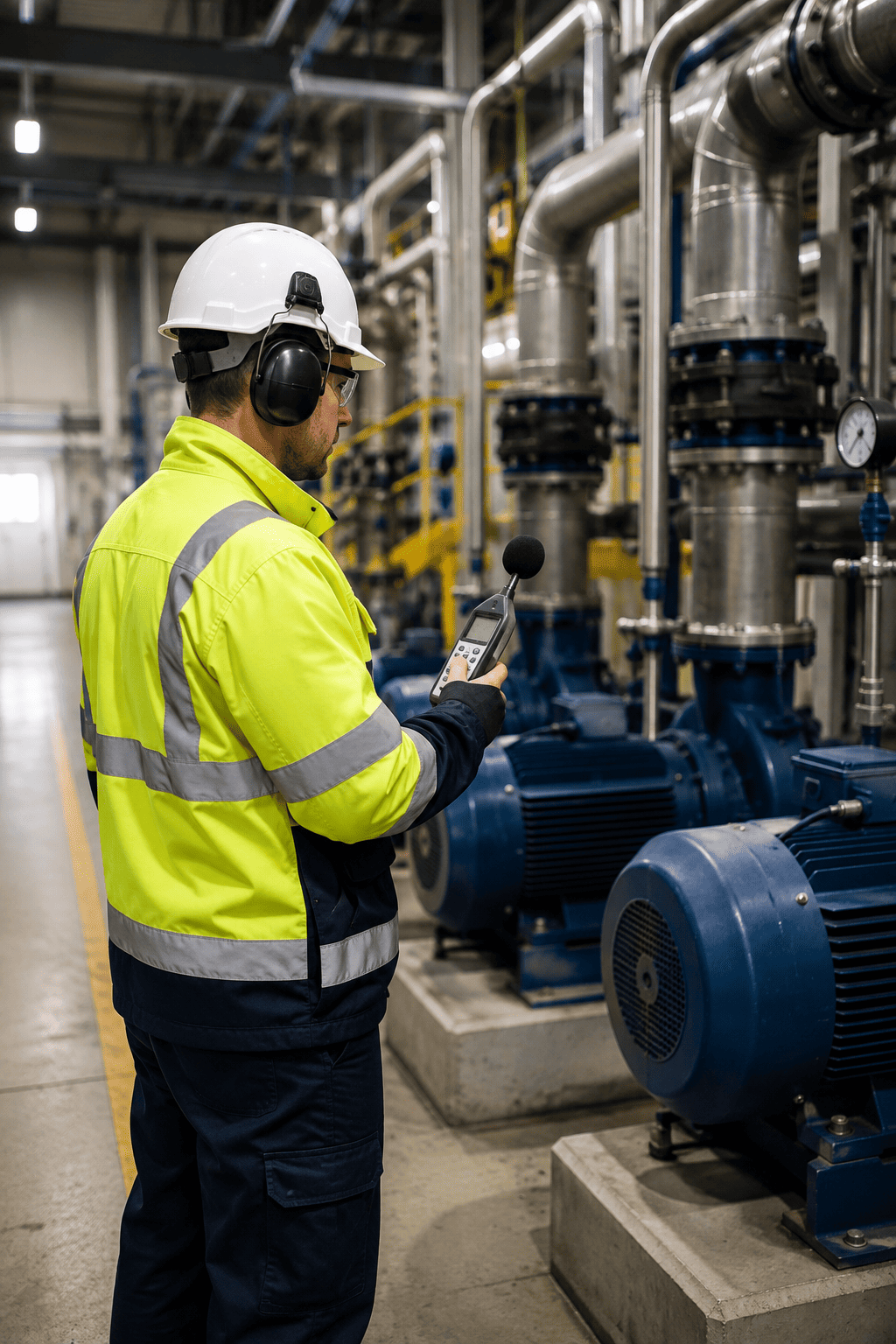
Exposure monitoring must be conducted when information indicates that employee noise exposures may equal or exceed 85 dBA TWA. Monitoring methods:
Monitoring must be repeated when there are changes in production, equipment, or controls that may increase exposures. Aggie Safety documents all monitoring with calibration records, employee exposure results, and comparison to action level and PEL thresholds.
OSHA Table G-16 defines permissible noise exposures. Aggie Safety documents and compares employee exposures against this table in every noise assessment report.
| Sound Level (dBA slow response) | Permissible Exposure Duration (hours/day) |
|---|---|
| 90 | 8 |
| 92 | 6 |
| 95 | 4 |
| 97 | 3 |
| 100 | 2 |
| 102 | 1.5 |
| 105 | 1 |
| 110 | 0.5 |
| 115 | 0.25 (or less) |
Exposures at or above 85 dBA TWA trigger the hearing conservation program. Exposures exceeding the 8-hour PEL of 90 dBA require feasible engineering or administrative controls in addition to hearing protection.
A comprehensive audiometric testing program includes baseline and annual audiograms for all employees at or above the action level. Aggie Safety conducts testing on-site at your facility:
Hearing protection must be provided to all employees exposed at or above the action level (85 dBA TWA). For employees exposed above the PEL (90 dBA TWA), hearing protection must be selected to reduce exposure to the PEL or below. Aggie Safety:
Annual training is required for all employees in the hearing conservation program. Training must cover effects of noise on hearing, purpose and use of hearing protection, advantages, disadvantages, and attenuation of types of protection, and the purpose of audiometric testing. Aggie Safety delivers training in English and Spanish, with documentation of completion suitable for OSHA recordkeeping requirements.
A written Noise Conservation Program document is required that covers all program elements. Aggie Safety develops or updates written programs that are facility-specific, reference the correct OSHA standard paragraphs, assign program responsibility to named positions, and include the monitoring, audiometric, HPD, training, and recordkeeping elements in a single auditable document.
OSHA requires retention of noise exposure measurements (2 years) and audiometric test records (duration of employment). Records must include the employee's name and job classification, date of audiogram, examiner's name and serial number of audiometer, employee's most recent noise exposure assessment, and measurements of background sound pressure levels in audiometric test rooms. Aggie Safety maintains digital records on behalf of clients with role-appropriate access and retention management.
Where noise exposures exceed the PEL, feasible engineering or administrative controls must be implemented. Aggie Safety evaluates engineering control options:
Aggie Safety documents the engineering control evaluation in the noise assessment report. Where controls are not feasible, that determination is documented with supporting rationale -- a requirement that is often overlooked but that OSHA inspectors check during noise program audits.
| Industry | Common High-Noise Sources | Typical Employee Exposure Range | Aggie Safety Services |
|---|---|---|---|
| Chemical / Petrochemical | Compressors, pumps, relief venting, turbines, process boilers | 85-105 dBA at equipment; lower in control rooms | Noise dosimetry survey, engineering control evaluation, audiometric program, HCP development |
| Manufacturing / Metal Fabrication | Stamping presses, grinders, lathes, CNC machines, HVAC systems | 90-110+ dBA at machinery; higher in confined spaces | Area monitoring and dosimetry, HPD selection, written HCP, annual audiometric testing |
| Oil and Gas Production / Upstream | Wellhead equipment, compressor stations, dehydrators, flares | 85-100+ dBA in production areas | Dosimetry, engineering control feasibility, HPD program, on-site audiometric testing |
| Construction | Concrete saws, jackhammers, heavy equipment, nail guns | 95-115 dBA — some of highest exposures in any industry | Construction-specific noise exposure assessment per 29 CFR 1926.52, HPD training, written HCP |
| Food Processing | Conveyor systems, packaging lines, blowers, mixers, CIP cleaning | 85-100 dBA in processing areas | Noise dosimetry, engineering controls evaluation (floor mats, enclosures), audiometric testing, audiometric program |
| Power Generation / Utilities | Turbines, generators, boiler feed pumps, cooling towers | 90-110 dBA in plant areas | Dosimetry survey, noise mapping, HPD selection, audiometric testing, engineering control support |
