
$29.95
• ~30 minutes • English & Spanish • Instant printable certificate
Complete the online course at your own pace, pass the written test, and download your Certificate of Completion immediately.
STEP 1
STEP 2
STEP 3
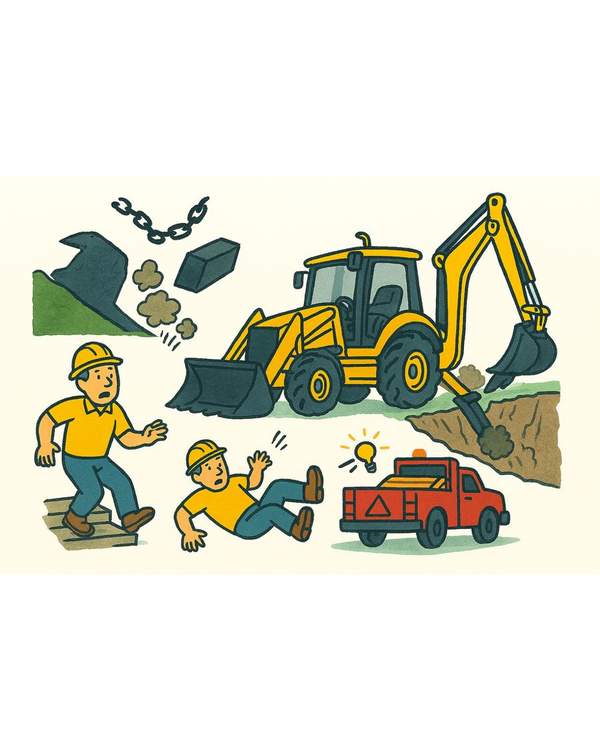
Backhoe accidents follow predictable patterns: overturns from turning too fast on slopes or carrying the bucket high, runovers from starting in gear or poor visibility, falls from improper mounting, and struck-by injuries to workers on the ground near the swing pivot. NIOSH's review of national fatality data found hundreds of deaths involving backhoe loaders and excavators — most of them nearby workers, not operators.
OSHA covers backhoes through the material handling equipment rules (29 CFR 1926.602), the general training duty (29 CFR 1926.21(b)(2)), and — because backhoes dig — the excavation standard (29 CFR 1926 Subpart P). Machines must have ROPS, working alarms and horns, and seat belts in use; operators must be trained; and trench work triggers the full Subpart P framework of shoring and spoil set-backs.
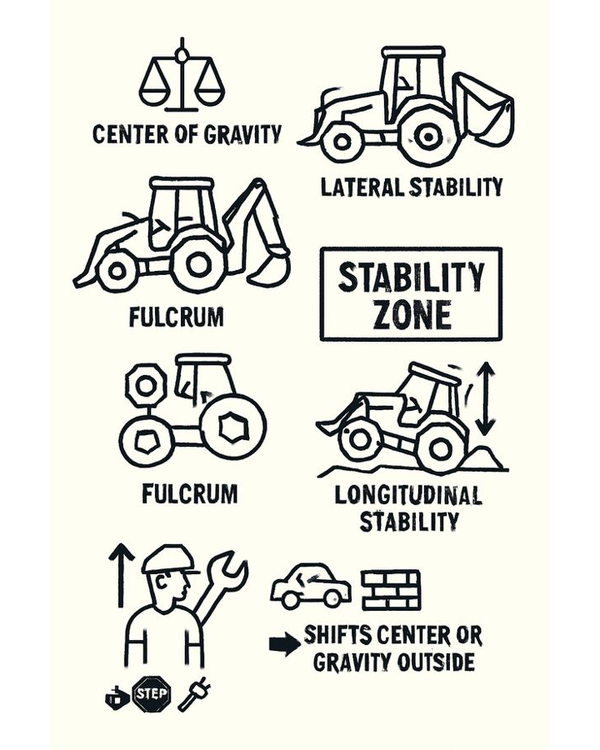
Our backhoe training is built around the stability engineering most courses skip: the stability zone, lateral and longitudinal stability, the rear tires acting as the fulcrum, and every action that moves the center of gravity — raising a load, adding attachments, low tire pressure, sharp turns, and slopes over 10%. Operators who understand why the machine tips stop doing the things that tip it.
The course teaches stability as a system — five terms, a set of triggers, and the slope numbers that keep the machine on its wheels.
| Term | What It Means on a Backhoe |
|---|---|
| Center of Gravity (CG) | The point where the machine's whole weight is concentrated — it moves with every action |
| Stability Zone | The safe zone the CG must stay inside; leave it and the machine tips or tumbles |
| Fulcrum | The rear tires act as the pivot point when unloaded |
| Lateral stability | Resistance to tipping sideways |
| Longitudinal stability | Resistance to tumbling forward or backward |
| What Shifts the CG Toward the Edge of the Zone | Counter-Measure Taught in the Course |
|---|---|
| Raising or extending a load | Keep loads low and close; tilt forks back to stabilize |
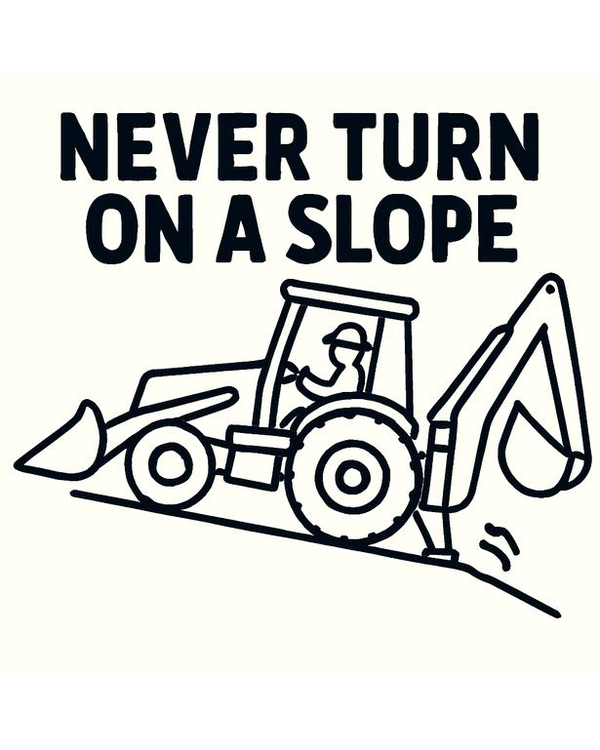
| Slopes over 10% grade (near 20% = dangerous) | Drive straight up/down; dump on the high side; experienced operators only on steep grades |
| Sharp turns and sudden stops | Slow, smooth inputs — about 5 MPH downhill, engine in gear |
| Low tire pressure | Check tires every shift — leaning becomes rolling on a slope |
| Narrow footprint | Deploy outriggers — they widen the stability zone; never operate with them raised near an excavation |
This backhoe training covers stability, inspection, excavation work, and transport, drawn directly from our field training program:
These visuals come directly from the Backhoe Safety Training course your team will take — practical, field-tested material, not stock theory.
The free PDF could compete with the paid-course CTA if it is too prominent above the fold.
The online course delivers the classroom instruction and written test; your employer or a qualified trainer then verifies hands-on skills using the included Operator Evaluation Checklist, and documents daily machine condition with the Inspection Checklist.
That two-part structure — formal instruction plus practical evaluation — is how OSHA expects equipment competency to be established and documented.

