OSHA Compliance & Support | Safety Inspections – Safety Audits | Cost-Effective Safety Consulting

Online Bridge Crane & Jib Crane Training and Certification

$29.95

~45 minutes English & Spanish Instant printable certificate

Bridge cranes and jib cranes move serious loads over people's heads all day, every day — and the accidents that follow bad rigging or skipped inspections are immediate and unforgiving. Our bridge and jib crane safety training online covers crane and hook assembly inspection, operator responsibilities, loading rules, and the basics of rigging, followed by a written test. Typical duration: 45 minutes.

🎁 Includes a FREE Operator Evaluation Checklist and Inspection Checklist — plus rigging basics are covered in this training at no extra cost.
  • Aligned with OSHA 29 CFR 1910.179 (overhead and gantry cranes) and 1910.184 (slings)
  • Covers bridge cranes, jib cranes, pendant controls, and rigging
  • Accepted in all states — 100% online course
  • Instant, printable Certificate of Completion
Certify Your Team Today. — Get Bridge Crane & Jib Crane Safety and OSHA Compliant

12%

of fatal crane incidents in a national analysis involved overhead or gantry cranes
Source: NCCCO / crane fatality studies

3+

broken wires on one strand of wire rope = the cable is weakened and must be reported before use
Source: Aggie Safety training program / ASME criteria

25%

capacity a sling loses in a choker hitch — before the lift even starts
Source: Rigging capacity standards
The Process

How It Works

Complete the online course at your own pace, pass the written test, and download your Certificate of Completion immediately.

STEP 1

Enroll & Start Your Online Course

  • Purchase the course and get instant access.
  • No prior bridge crane experience needed.
  • Learn OSHA safety rules, hazard recognition, and compliance requirements — all online.
  • This online course covers the formal instruction portion.

STEP 2

Complete the Course & Download Your Certificate

  • Study at your own pace and pass the online test.
  • Retake the test as many times as you need at no extra charge.
  • Immediately download and print your Certificate of Completion.

STEP 3

Site-Specific Assignment With Your Employer

  • Your employer or trainer uses our free Operator Evaluation Checklist for the practical qualification OSHA expects.
  • Daily crane and rigging inspections are documented with the included Inspection Checklist.

The Risk Is Real

Why Bridge Crane & Jib Crane Training Matters

Overhead crane accidents trace back to a short list of causes: nobody checked the load weight against crane capacity, the rigging was improper or damaged, a side pull set the load swinging, mechanical defects like frayed cables and bent hooks stayed in service, or the travel path was never inspected. In one incident covered in this course, a moving bridge struck a scissor lift and dropped a worker 30 feet — a five-second travel-path check would have prevented it.

OSHA regulates overhead and gantry cranes under 29 CFR 1910.179 and slings under 29 CFR 1910.184 — frequent and periodic inspections, hook and hoist criteria, and rigging removal-from-service rules. Unlike mobile construction cranes, overhead crane operators are trained and qualified by the employer, which makes documented training the backbone of compliance.

This course puts unusual weight on rigging, because rigging is where overhead crane work goes wrong: daily inspection of chains, wire rope, and synthetic slings; removal criteria like three broken wires, missing tags, and visible wear cords; hitch selection and the capacity math behind vertical, choker, and basket configurations; and the shackle and eye bolt rules that prevent improvised — and fatal — connections.

What causes overhead crane accidents
  • Load weight never checked against crane capacity
  • Improper rigging — wrong hitch, damaged sling, covered tag
  • Side pulls that set the load swinging
  • Frayed wire rope, bent hooks, and stretched chain left in service
  • Travel path not inspected — collisions with equipment and people
  • Loads carried over workers
  • Walking backward while guiding a moving load
Regulatory note: Jib cranes handle 250 lbs to 15 tons and follow the same safety rules as bridge cranes with few exceptions — including base plate inspection for corrosion and missing nuts, covered in this course.
Technical Deep Dive

Rigging Capacity Math and Removal Criteria

Overhead crane safety is arithmetic plus inspection discipline. The course teaches both with the numbers below.

Safety factor: safe working load = rated breaking strength ÷ safety factor. Course example: a chain rated at 10,000 lbs with a safety factor of 5 carries a safe load of 2,000 lbs. Chains: minimum breaking strength ÷ 4; always confirm your company's factor with a supervisor.

Hitch / Angle Capacity (500-lb vertical-rated sling example)
Vertical hitch 500 lbs — full rated capacity, but the load can rotate
Choker hitch ~375 lbs (−25% from compression); pull tight before the lift, never during
Basket hitch at 90° 1,000 lbs (2×) — requires a spreader bar or two lifting devices
Basket at 30° half the strength of a 90° basket; angles under 30° are prohibited, 60°+ preferred
Component Remove from Service When...
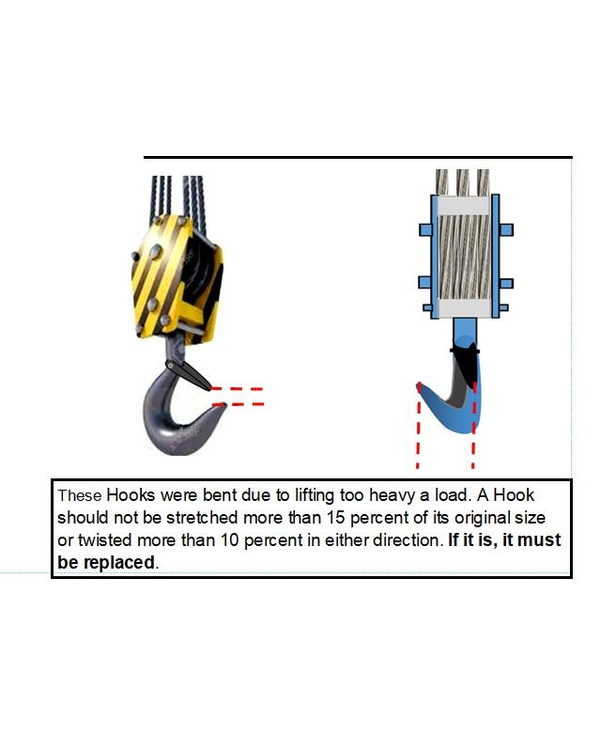
Hook Stretched more than 15% of original throat opening or twisted more than 10%
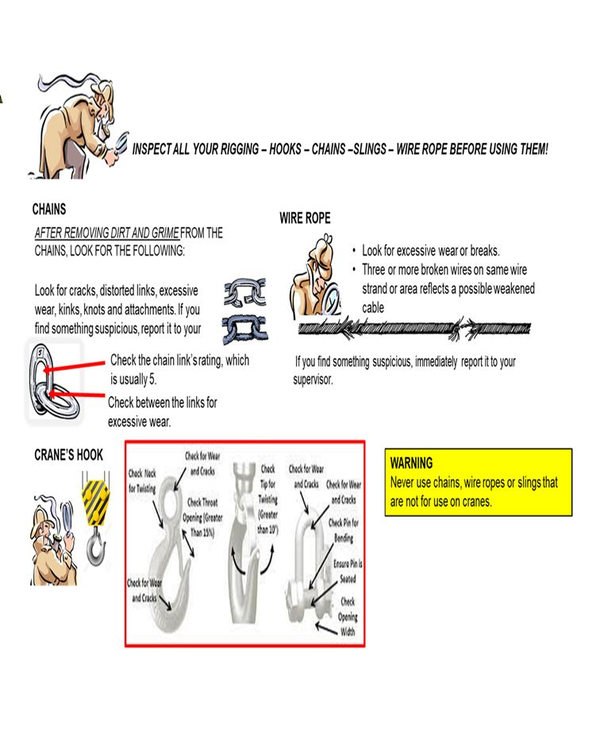
Wire rope 3 or more broken wires on a single strand
Chain Cracks, distorted links, wear, kinks, knots — and grade marking below 5
Synthetic sling Missing tag, burns, cuts, broken stitching, or a visible red/blue wear cord (destroy the sling)
New slings Must be proof-tested to 2× rated load — certificates available from the manufacturer

Course Outline

What You’ll Learn in This Training

This bridge crane and jib crane training covers inspection, operation, and rigging fundamentals:

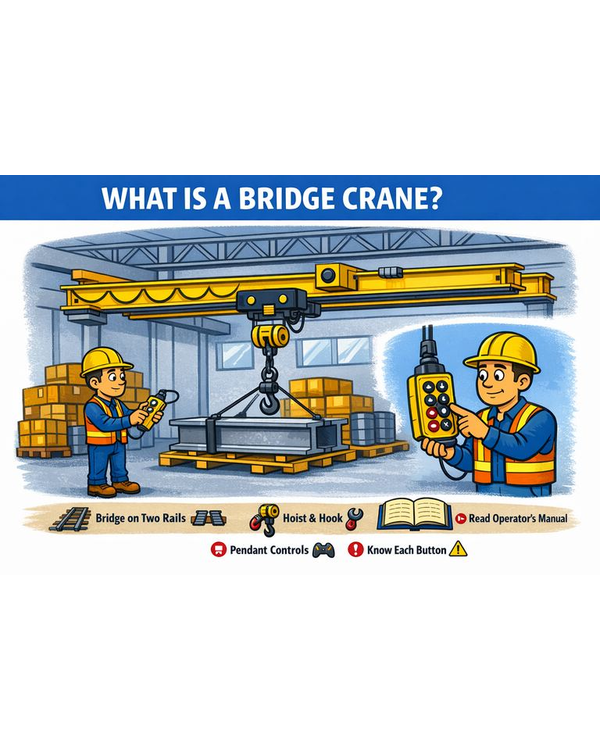
✔ How bridge cranes work: bridge, trolley, hoist, hook, and pendant controls
✔ Jib cranes: arc operation, capacities, and base plate inspection
✔ Crane and hook assembly inspection — daily and periodic
✔ Wire rope and drum wrapping inspection
✔ Brake, limit switch, and emergency stop testing
✔ Operator responsibilities: load weight, capacity, communication, signals
✔ Loading rules: center the hook, no side pulls, no loads over people
✔ Safety factor math: rated strength ÷ safety factor = safe working load
✔ Basics of rigging: chain, wire rope, and synthetic sling inspection
✔ Sling removal criteria: broken wires, cuts, burns, wear cords, missing tags
✔ Hitch types and capacities: vertical, choker, basket, double basket
✔ Sling angles — why below 30° is prohibited
✔ Shackles, eye bolts, and swivel hoist rings
✔ Common causes of crane accidents and how to break the chain
✔ Parking the crane and trolley correctly
✔ ONLINE WRITTEN TEST

Inside The Course

Straight From the Training Material

These visuals come directly from the Bridge Crane & Jib Crane Training course your team will take — practical, field-tested material, not stock theory.
OSHA compliance services Houston

bridge crane anatomy — bridge on two rails, hoist and hook on the trolley, pendant controls.

daily rigging inspection — chains for distorted links, wire rope for broken strands, hooks for stretch and twist.

OSHA compliance services Houston

these hooks bent under overload. A hook stretched more than 15% or twisted more than 10% must be replaced.

Why Train With Aggie Safety

Benefits of Training with Aggie Safety

Increase safety
Operators learn inspection discipline and rigging judgment — the two skills that keep loads off people.
Rigging included
Basics of rigging are built into this training: sling inspection, hitch capacity, angles, and hardware — no separate course needed.
Ensure compliance
Documented employer-based training is exactly how OSHA 1910.179 competency works. Certificate and checklists give you the paper trail.
Reduce costs
A dropped load damages product, equipment, and people. Inspection habits from this course catch defects while they're cheap.
Fast and practical
45 minutes online, written test included, certificate printed the same day.
Your Credential

Employer-Based Qualification Done Right

For overhead and gantry cranes, OSHA places training and qualification with the employer — there is no third-party certification requirement as with mobile construction cranes. That makes your documentation the whole story: formal instruction, written test, and a practical evaluation.

This course provides the first two and equips the third: your employer or trainer uses the included Operator Evaluation Checklist for hands-on verification and the Inspection Checklist for daily crane and rigging inspections.

  • Certificate of Completion — downloadable and printable immediately
  • Operator Evaluation Checklist for hands-on verification
  • Crane & rigging Inspection Checklist for daily documentation
  • Free test retakes until you pass
OSHA forklift certification online completion

Frequently Asked questions

Do overhead crane operators need third-party certification like mobile crane operators?
No. OSHA's accredited-certification requirement (29 CFR 1926.1427) applies to most mobile construction cranes — overhead and gantry cranes under 29 CFR 1910.179 rely on employer-provided training and qualification. That means documented training like this course, plus a hands-on evaluation by your employer, is the compliance backbone.
What is a side pull and why is it dangerous?
A side pull is lifting a load that is not directly under the hook, so the load swings toward center the instant it leaves the ground. Side pulls injure workers, damage the hoist drum and wire rope, and are prohibited — always center the hook directly over the load before lifting.
When must a sling be removed from service?
Immediately when inspection finds any of: a missing or illegible tag, burns, melting or weld spatter, holes, tears, cuts or snags, broken or worn stitching, knots, distorted or corroded fittings, or a visible red/blue wear cord in synthetic slings. For wire rope, three or more broken wires on one strand means the cable is weakened; for chain, cracks, stretch, or distorted links fail it.
How do hitch types affect lifting capacity?
A vertical hitch delivers full rated capacity; a choker hitch reduces capacity by about 25% because the sling compresses on itself; a basket hitch at 90 degrees doubles capacity because two legs share the load. Sling angle matters too — capacity falls as the angle drops, and angles below 30 degrees are prohibited.
Does this course cover jib cranes specifically?
Yes. Jib cranes — wall or pillar-mounted booms that move loads in an arc, handling 250 lbs to 15 tons — follow the same safety rules as bridge cranes with a few additions covered in the course, including base plate corrosion checks and correct trolley parking at the support column.
How long is the course?
Most students complete the course in the typical duration listed above. You can start and stop whenever it is convenient — your progress is saved, and there is no time limit to finish.
If I fail the test, do I have to pay to take it again?
No. You may retake the test as many times as you need to pass at no additional charge.
Is your course approved by OSHA?
OSHA does not formally approve any training company or material — it publishes the requirements training must cover. Our silica training course is built to meet and exceed those OSHA training requirements.
How quickly do I get proof of completion?
Immediately. As soon as you pass the online test, you can download and print your personalized Certificate of Completion to show your employer.
Do you offer refunds?
Yes. If you purchased within the last 5 days, have not completed the course, and have not generated your certificate, you are eligible for a full refund — no questions asked. Contact our support team at info@lonestar-losscontrol.com with your order details.
Where is the certificate accepted?
The certificate is accepted in all U.S. states, and in any country that follows OSHA-based requirements, including Canada and Mexico.
Aggie Safety Logo
Your safety partner in OSHA compliance and workforce protection.
  • 6001 Savoy Dr Suite #201B, Houston, TX 77036, USA
  • 8AM – 5PM Monday – Friday
© 2026 Aggie Safety | All Rights Reserved.