OSHA Compliance & Support | Safety Inspections – Safety Audits | Cost-Effective Safety Consulting

Noise Conservation Program & Audiometric Testing
in Houston, TX

Protect your workforce from noise-induced hearing loss with a fully OSHA-compliant Noise Conservation Program — built around on-site audiometric testing, so your team never has to leave the facility to stay compliant. From noise exposure assessment to written program development, hearing protection, and digital recordkeeping, Aggie Safety manages the entire program lifecycle for industrial, manufacturing, construction, and chemical facilities across Houston and the Gulf Coast.

Noise Conservation Program

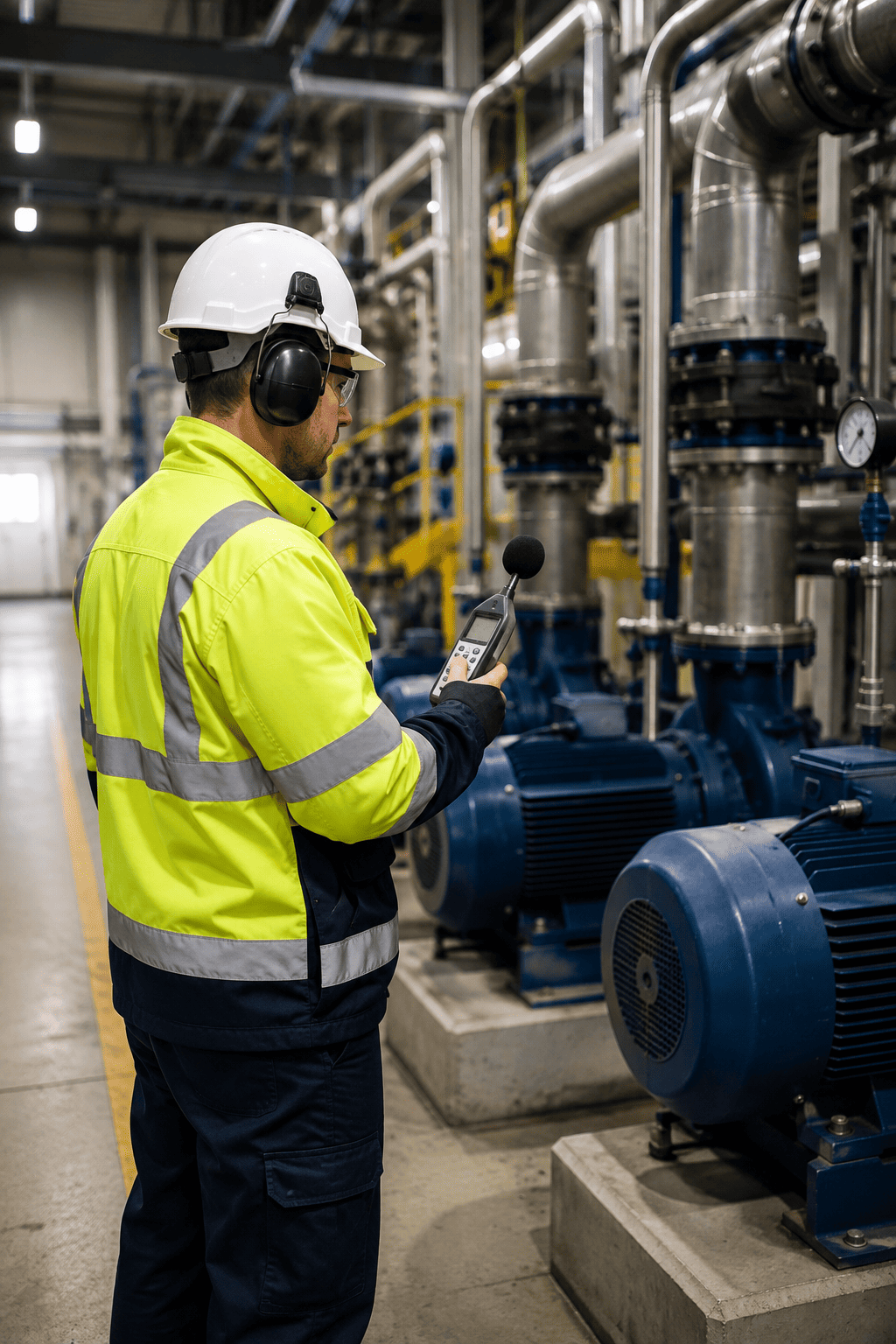
Aggie Safety provides OSHA-compliant Noise Conservation Programs for industrial, manufacturing, construction, and chemical facilities across Houston and the Gulf Coast. Our services cover the complete program lifecycle: noise exposure assessment using calibrated dosimeters and sound level meters, written hearing conservation program development, hearing protection selection and training, and -- uniquely -- on-site audiometric testing conducted at your facility rather than requiring employees to visit an offsite clinic.
Noise-induced hearing loss (NIHL) is the second most common occupational illness in the United States and the most common work-related injury in manufacturing. Unlike acute injuries, NIHL is cumulative and irreversible -- workers lose hearing gradually over years of exposure before the loss is recognized. By the time a standard threshold shift shows up in the audiometric record, years of preventable damage have already occurred. The purpose of an OSHA-compliant Noise Conservation Program is to catch the exposure problem before the hearing loss becomes permanent -- with noise monitoring, engineering controls, hearing protection, and audiometric surveillance working together as a system.

OSHA Noise Standard (29 CFR 1910.95): Employers must implement a Noise Conservation Program (also called Hearing Conservation Program) when worker noise exposures equal or exceed 85 dBA as an 8-hour time-weighted average (TWA). This is the action level -- not the Permissible Exposure Limit (PEL). The PEL is 90 dBA TWA. Between 85 and 90 dBA, all hearing conservation program elements are required. Above 90 dBA, engineering or administrative controls must be implemented to bring exposure below the PEL. Noise violations are among the top 10 most cited OSHA standards in general industry.
OSHA compliance services Houston

Key Takeaways

  • The OSHA action level for noise is 85 dBA as an 8-hour TWA. At or above this level, employers must implement a full Noise Conservation Program -- monitoring, audiometric testing, hearing protection, training, and recordkeeping -- regardless of whether the PEL of 90 dBA is exceeded.
  • The Permissible Exposure Limit (PEL) for noise is 90 dBA as an 8-hour TWA using a 5 dB exchange rate. For each 5 dB increase above 90 dBA, the permissible exposure time is halved: 95 dBA for 4 hours, 100 dBA for 2 hours, 105 dBA for 1 hour, 110 dBA for 30 minutes. Exposures exceeding the PEL require feasible engineering or administrative controls.
  • Audiometric testing is mandatory under 29 CFR 1910.95(g) for all employees whose noise exposures equal or exceed the action level. A baseline audiogram must be established within 6 months of first exposure (or within 1 year for mobile test van programs). Annual audiograms compare against the baseline to detect Standard Threshold Shifts (STS).
  • A Standard Threshold Shift (STS) is a change in hearing threshold of 10 dB or more, averaged across 2000, 3000, and 4000 Hz frequencies, in either ear. An STS must be recorded on the OSHA 300 log if the STS is work-related and represents a material impairment to hearing. It triggers a mandatory review of the employee's exposure and the adequacy of their hearing protection.
  • Aggie Safety conducts audiometric testing on-site at your facility using a calibrated mobile audiometric booth. Employees are tested without leaving the facility, eliminating transportation time, reducing compliance gaps from employees who do not attend offsite testing, and ensuring testing is completed on schedule.
  • Engineering controls -- sound enclosures, vibration damping, equipment substitution, maintenance to eliminate bearing noise -- must be implemented where feasible before relying on hearing protection as the primary control. Aggie Safety's noise assessment includes engineering control feasibility evaluation, not just HPD selection.
OSHA REQUIREMENTS

What OSHA 29 CFR 1910.95 Requires:
A Complete Noise Conservation Program

A fully compliant Noise Conservation Program under 29 CFR 1910.95 has eight required elements. Aggie Safety provides support across all eight.

1. Noise Monitoring

Exposure monitoring must be conducted when information indicates that employee noise exposures may equal or exceed 85 dBA TWA. Monitoring methods:

  • Personal noise dosimetry: a dosimeter worn by the employee throughout the work shift, measuring cumulative noise dose. This is the most accurate method for mobile workers or those in varying-noise environments. Aggie Safety uses OSHA-compliant dosimeters set to the 5 dB exchange rate and 80 dBA threshold.
  • Area monitoring with sound level meters: appropriate for fixed workstations with consistent noise environments. Aggie Safety uses Type 2 or Type 1 sound level meters in A-weighted slow response mode as required by OSHA.

Monitoring must be repeated when there are changes in production, equipment, or controls that may increase exposures. Aggie Safety documents all monitoring with calibration records, employee exposure results, and comparison to action level and PEL thresholds.

2. Noise Exposure Reference Table

OSHA Table G-16 defines permissible noise exposures. Aggie Safety documents and compares employee exposures against this table in every noise assessment report.

Sound Level (dBA slow response) Permissible Exposure Duration (hours/day)
90 8
92 6
95 4
97 3
100 2
102 1.5
105 1
110 0.5
115 0.25 (or less)

Exposures at or above 85 dBA TWA trigger the hearing conservation program. Exposures exceeding the 8-hour PEL of 90 dBA require feasible engineering or administrative controls in addition to hearing protection.

3. Audiometric Testing Program

A comprehensive audiometric testing program includes baseline and annual audiograms for all employees at or above the action level. Aggie Safety conducts testing on-site at your facility:

  • Baseline audiogram: establishes the reference hearing level for each employee. Must be preceded by at least 14 hours away from workplace noise (or ear protection worn for 14 hours prior to testing). It is conducted by Aggie Safety Certified technician.
  • Annual audiogram: conducted within one year of the baseline and annually thereafter for all employees in the hearing conservation program. It is conducted by Aggie Safety Certified technician.
  • Audiogram review: Aggie Safety's certified audiologist reviews each audiogram for Standard Threshold Shifts, referrals, and program effectiveness evaluation.
  • On-site testing advantage: Aggie Safety's mobile audiometric booth eliminates the logistical barriers to compliance -- no transportation required, no lost work time for travel, no compliance gaps from employees who miss scheduled offsite appointments. Testing comes to your facility on a date your team selects and conducted by Aggie Safety certified technician.
4. Hearing Protection Devices (HPD)

Hearing protection must be provided to all employees exposed at or above the action level (85 dBA TWA). For employees exposed above the PEL (90 dBA TWA), hearing protection must be selected to reduce exposure to the PEL or below. Aggie Safety:

  • Evaluates HPD Noise Reduction Ratings (NRR) against actual employee exposures using the OSHA derating method
  • Recommends appropriate HPD types (foam earplugs, pre-molded earplugs, earmuffs, combined protection) for the specific noise environment
  • Evaluates hearing protection fit and use during on-site visits -- an employee wearing an earplug incorrectly receives a fraction of the labeled NRR
  • Documents HPD availability and ensures employees have access to the required protection at no cost
5. Training Program

Annual training is required for all employees in the hearing conservation program. Training must cover effects of noise on hearing, purpose and use of hearing protection, advantages, disadvantages, and attenuation of types of protection, and the purpose of audiometric testing. Aggie Safety delivers training in English and Spanish, with documentation of completion suitable for OSHA recordkeeping requirements.

6. Written Noise Conservation Program

A written Noise Conservation Program document is required that covers all program elements. Aggie Safety develops or updates written programs that are facility-specific, reference the correct OSHA standard paragraphs, assign program responsibility to named positions, and include the monitoring, audiometric, HPD, training, and recordkeeping elements in a single auditable document.

7. Recordkeeping

OSHA requires retention of noise exposure measurements (2 years) and audiometric test records (duration of employment). Records must include the employee's name and job classification, date of audiogram, examiner's name and serial number of audiometer, employee's most recent noise exposure assessment, and measurements of background sound pressure levels in audiometric test rooms. Aggie Safety maintains digital records on behalf of clients with role-appropriate access and retention management.

8. Engineering and Administrative Controls

Where noise exposures exceed the PEL, feasible engineering or administrative controls must be implemented. Aggie Safety evaluates engineering control options:

  • Equipment maintenance: worn bearings, loose guards, and poorly lubricated machinery are frequent noise sources that can be corrected through maintenance -- at low cost compared to enclosure projects
  • Equipment substitution: lower-noise process equipment or tooling where available
  • Sound enclosures: partial or full enclosures around high-noise sources with absorptive lining
  • Vibration damping: isolation mounts and damping materials for high-vibration machinery
  • Administrative controls: job rotation to limit individual exposure duration, repositioning workstations away from noise sources

Aggie Safety documents the engineering control evaluation in the noise assessment report. Where controls are not feasible, that determination is documented with supporting rationale -- a requirement that is often overlooked but that OSHA inspectors check during noise program audits.

INDUSTRIES SERVED

Industries Served: Noise Conservation in Houston

Industry Common High-Noise Sources Typical Employee Exposure Range Aggie Safety Services
Chemical / Petrochemical Compressors, pumps, relief venting, turbines, process boilers 85-105 dBA at equipment; lower in control rooms Noise dosimetry survey, engineering control evaluation, audiometric program, HCP development
Manufacturing / Metal Fabrication Stamping presses, grinders, lathes, CNC machines, HVAC systems 90-110+ dBA at machinery; higher in confined spaces Area monitoring and dosimetry, HPD selection, written HCP, annual audiometric testing
Oil and Gas Production / Upstream Wellhead equipment, compressor stations, dehydrators, flares 85-100+ dBA in production areas Dosimetry, engineering control feasibility, HPD program, on-site audiometric testing
Construction Concrete saws, jackhammers, heavy equipment, nail guns 95-115 dBA — some of highest exposures in any industry Construction-specific noise exposure assessment per 29 CFR 1926.52, HPD training, written HCP
Food Processing Conveyor systems, packaging lines, blowers, mixers, CIP cleaning 85-100 dBA in processing areas Noise dosimetry, engineering controls evaluation (floor mats, enclosures), audiometric testing, audiometric program
Power Generation / Utilities Turbines, generators, boiler feed pumps, cooling towers 90-110 dBA in plant areas Dosimetry survey, noise mapping, HPD selection, audiometric testing, engineering control support

Frequently Asked questions

Answers to the most common questions about OSHA compliance, safety training, and working with Aggie Safety.
What is OSHA's noise standard and when does a Noise Conservation Program become required?
OSHA's occupational noise standard is 29 CFR 1910.95 for general industry and 29 CFR 1926.52 for construction. A Noise Conservation Program (also called Hearing Conservation Program) is required when employee noise exposures equal or exceed 85 dBA as an 8-hour time-weighted average (TWA). This is the action level, not the Permissible Exposure Limit. The PEL is 90 dBA TWA. Between 85 and 90 dBA, all program elements -- monitoring, audiometric testing, hearing protection, and training -- are required. Above 90 dBA, feasible engineering or administrative controls must also be implemented to reduce exposures below the PEL.
What is the difference between the action level and the PEL for noise?
The OSHA action level for noise is 85 dBA as an 8-hour TWA. At or above this level, employers must implement a full Hearing Conservation Program. The Permissible Exposure Limit (PEL) is 90 dBA as an 8-hour TWA. Exposures above the PEL require feasible engineering or administrative controls -- not just hearing protection. Using the 5 dB exchange rate, the permissible exposure duration halves with every 5 dB increase: 95 dBA for 4 hours, 100 dBA for 2 hours, 105 dBA for 1 hour. Hearing protection alone cannot satisfy the PEL requirement -- controls must be attempted first, with hearing protection as a supplement.
What is a Standard Threshold Shift (STS) and what does it require?
A Standard Threshold Shift (STS) is defined by OSHA as a change in hearing threshold of 10 dB or more, averaged across the 2000, 3000, and 4000 Hz frequencies, in either ear compared to the baseline audiogram. An STS triggers mandatory follow-up: the employee must be re-tested within 30 days to confirm the shift, their noise exposure must be reviewed, the adequacy of their hearing protection must be evaluated, and they must be referred for further evaluation if the STS persists. An STS that is work-related and represents material impairment must be recorded on the OSHA 300 log. Aggie Safety's audiometric program includes STS identification, notification, and follow-up documentation.
Why does Aggie Safety conduct audiometric testing on-site?
Aggie Safety conducts audiometric testing at your facility using a mobile audiometric booth rather than requiring employees to travel to an offsite clinic. The advantages are significant: no lost productivity from employee travel, no compliance gaps from employees who miss scheduled offsite appointments, faster completion of the annual audiometric cycle, and the ability to conduct baseline audiograms within the 6-month window required by OSHA. For facilities with large numbers of employees in the hearing conservation program, on-site testing is the only practical way to complete the annual cycle on schedule. Aggie Safety schedules on-site testing dates coordinated with your shift schedule to maximize participation.
Does a construction employer need a Noise Conservation Program?
Yes. Construction employers with employees exposed to noise at or above 90 dBA as an 8-hour TWA must comply with 29 CFR 1926.52. However, the construction standard is less prescriptive than the general industry standard -- it requires controls or hearing protection above the PEL but does not specify audiometric testing or written program elements as explicitly as 29 CFR 1910.95. Many construction employers adopt a Hearing Conservation Program modeled on 29 CFR 1910.95 as a best practice, particularly when employees are exposed at levels between 85 and 90 dBA. Aggie Safety provides noise conservation programs for construction employers calibrated to 29 CFR 1926.52 requirements.
How is noise dosimetry different from a sound level meter reading?
A sound level meter reading provides an instantaneous or short-duration measurement of noise level at a specific location. It is useful for area monitoring at fixed workstations with consistent noise. A noise dosimeter is worn by the employee throughout the work shift and measures cumulative noise dose, accounting for variations in noise level as the employee moves between work areas, operates different equipment, and takes breaks. OSHA allows both methods for compliance monitoring, but personal dosimetry is required when workers move between different noise environments or when it is not practical to characterize the noise environment with area measurements alone. Aggie Safety uses both methods, selecting the appropriate approach based on the work activity and noise environment.
What records must be kept for an OSHA noise conservation program?
OSHA requires two types of records: noise exposure measurement records, which must be retained for 2 years; and audiometric test records, which must be retained for the duration of employment. Audiometric records must include the employee's name and job classification, date of audiogram, examiner qualifications, audiometer calibration records, employee noise exposure assessment, and background sound pressure level measurements in the test room. Aggie Safety maintains digital records for clients with appropriate retention management and provides records on demand for OSHA inspections or workers' compensation proceedings.
How often must noise monitoring be repeated?
OSHA requires noise monitoring to be repeated whenever a change in production, process, equipment, or controls may result in new or additional exposures at or above the action level. There is no fixed re-monitoring interval if conditions have not changed. However, Aggie Safety recommends re-monitoring every 2 to 3 years for active industrial facilities, or after any significant equipment change, production rate change, or modification to noise controls, to ensure the exposure assessment remains current. Monitoring results are also needed to update the written program and to inform hearing protection selection when the noise environment changes.
Noise Assessment and Audiometric Testing

Schedule Your Noise Assessment and Audiometric Testing in Houston

Whether you need a baseline noise exposure survey, a full Noise Conservation Program, on-site audiometric testing, written program development, or employee training, Aggie Safety provides the complete service in one engagement. Call (713) 613-2830 or fill out the form below.
Aggie Safety serves industrial and manufacturing facilities throughout Greater Houston, including Harris County, Baytown, Pasadena, Deer Park, Texas City, Freeport, and the Gulf Coast industrial corridor.

Related Services

Aggie Safety Logo
Your safety partner in OSHA compliance and workforce protection.
  • 6001 Savoy Dr Suite #201B, Houston, TX 77036, USA
  • 8AM – 5PM Monday – Friday
© 2026 Aggie Safety | All Rights Reserved.