
$19.95
• ~30 minutes • English & Spanish • Instant printable certificate
Complete the online course at your own pace, pass the written test, and download your Certificate of Completion immediately.
STEP 1
STEP 2
STEP 3
Excavators are among the most powerful machines on a jobsite — and among the least forgiving. NIOSH investigations show most excavator-related deaths are struck-by incidents: workers caught by a swinging boom, run over by a moving machine, or hit by a bucket that detached from a quick coupler. Operators themselves are at risk from tip-overs on slopes, soft soil, and trench edges.
OSHA does not publish a standalone excavator certification standard, but it does require employers to instruct every employee in the recognition and avoidance of unsafe conditions under 29 CFR 1926.21(b)(2), and it enforces excavator-related hazards through the excavation standard (29 CFR 1926 Subpart P), the material-handling equipment rules (29 CFR 1926.602), and the General Duty Clause. An untrained operator is an open citation — and an open risk to every worker on the ground.
Our excavator training gives operators the engineering understanding behind the rules: how the center of gravity moves with every boom swing, why tracks must never be set parallel to a trench wall, and what a travel-path inspection must cover before the machine ever moves.
These are the working rules taught in the course — the specifics operators are tested on.
| Rule | Requirement Taught in the Course |
|---|---|
| Trench shoring trigger | Trenches deeper than 5 ft must be shored before entry |
| Spoil placement | Drop spoil far enough back — minimum 2 ft from the trench edge |
| Track positioning | Tracks never parallel to a trench wall; stay on the same side while digging |
| Slope travel | Straight up and down only, bucket low, loads on the high side |
| Mount/dismount | 3-point contact always; never jump off — even after electrical contact, stay on the machine |
| Utilities | Clear with the utility company before digging; inspect the travel path for soft earth |
| Parking | Bucket and blade lowered, controls neutral, engine cooled, key removed |
The stability principle behind all of it: the machine's center of gravity must stay inside the stability box. Every boom swing, bucket load, sudden stop, and slope shifts the CG — narrow machines like mini excavators tip when it leaves the box.
This comprehensive online excavator training covers the theory OSHA requires for safe operation, drawn directly from our field training program:
These visuals come directly from the Excavator Training course your team will take — practical, field-tested material, not stock theory.
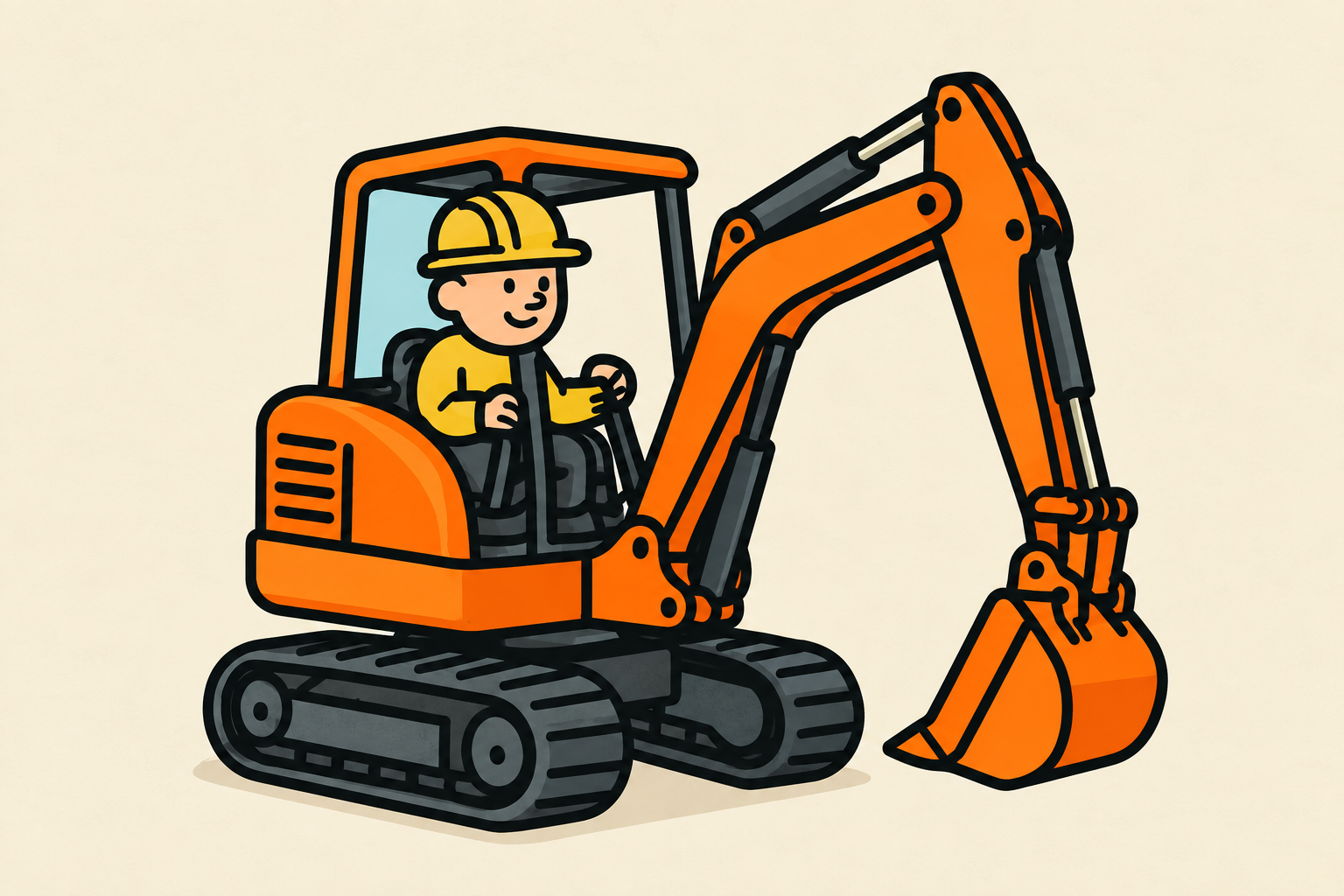
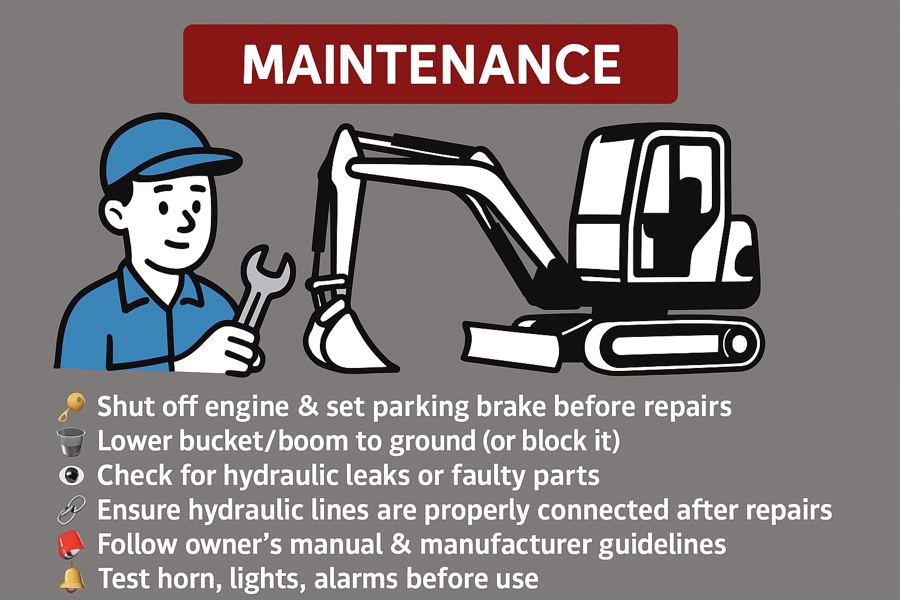
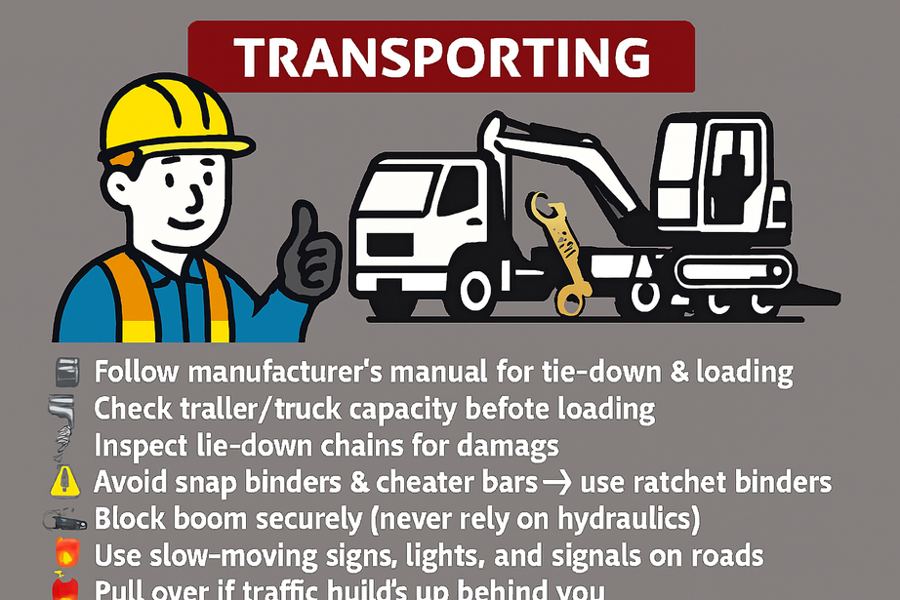
Download a printable checklist for evaluating practical excavator operating skills.
Our program is built on decades of hands-on equipment training experience. The online course delivers the classroom instruction and written test; your employer or a qualified trainer then verifies hands-on skills using the included Operator Skill Competency Test — the same two-part structure OSHA uses for powered industrial equipment.
You'll be trained on the engineering behind excavator stability — not just a list of rules — so you can adapt safely to new machines, new sites, and new soil conditions.

