OSHA Compliance & Support | Safety Inspections – Safety Audits | Cost-Effective Safety Consulting

Aerial Lift, Scissor Lift & Boom Lift Safety Certification — Online

$44.95

  1 hour    70% to pass, free retakes     Instant printable certificate  •  Accepted nationwide
Complete the formal classroom training online, at your own pace — built to 29 CFR 1926.453 and 1926.454 and the ANSI A92 MEWP standards, from 25 years of experience training aerial and scissor lift operators. Pass the quiz, download your certificate, and hand your employer the included Practical Evaluation & Inspection Checklist for the hands-on portion.
Certify Your Team Today. — Get Aerial Lift, Scissor Lift & Boom Lift Certified and OSHA Compliant
The Process

How It Works

OSHA requires three components for full aerial lift certification. Aggie Safety delivers Step 1 online — fully and completely. Steps 2 and 3 happen at your workplace.

STEP 1

Enroll & Start Your Online Course

  • Purchase the course and get instant access
  • No prior aerial lift experience needed
  • Learn OSHA regulations, hazard types, engineering principles, fall protection, inspection requirements, and tip-over prevention
  • This covers the formal classroom instruction requirement

STEP 2

Pass the Exam & Print Your Certificate

  • Pass the quiz at 70% or higher — retake free, as many times as needed
  • Immediately download your Certificate of Completion
  • Certificate documents you have met the written/classroom requirement
  • You also receive a free Practical Evaluation & Aerial Lift Inspection Checklist

STEP 3

Hands-On Evaluation with Your Employer

  • Your employer or a qualified trainer conducts the practical evaluation using our free checklist
  • Evaluation covers actual operation, pre-use inspection, and site-specific hazards
  • OSHA requires the evaluator to be a qualified person with experience on that specific lift model
  • Full certification is complete — required for every aerial lift operator on any job site

four chapters

See What's Actually Inside the Course

Chapter One

Choosing the Right Lift Is a Safety Decision

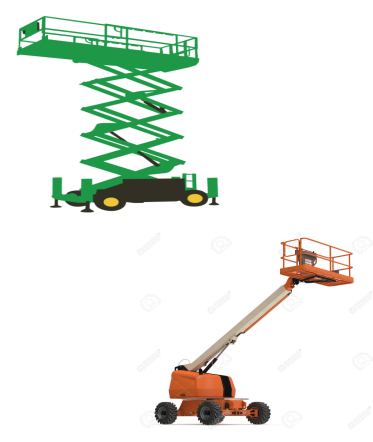
The course opens where accidents actually start: equipment selection. A boom lift is more maneuverable and rises higher; a scissor lift carries more workers and supplies; rough terrain requires a lift designed for it. Fall protection differs by type — on a scissor lift with safety rails in good condition and no missing parts, a harness is not required; on a boom lift, a harness with a restraint lanyard is mandatory, sized short enough to stop you from being thrown over the safety rails. That ejection scenario is why boom lifts use restraint — not shock-absorbing — lanyards.

Chapter Two

The Stability Box

Every aerial lift has a stability box: as long as the center of gravity stays inside it, the lift is stable; outside it, lateral or longitudinal stability is lost and the lift tips. The course names the four moves that push the CG out of the box: turning too fast, a tire hitting a hole, lifting or turning on an incline, and lifting too heavy a load. This is why the rules exist — never operate or turn with a raised platform on an incline, and never exceed rated load.

Chapter Three

Safety Guidelines Most Courses Don't Teach

  • Power lines: keep a minimum 10 feet from power lines and transformers — and for high-voltage lines, the course teaches 50 feet or more (a stricter, field-proven rule the current page doesn't mention)
  • Hydraulics: check fluid levels every shift — if hydraulic pressure drops too low, the platform can suddenly drop; lines carry 2,000+ psi, enough to inject fluid through skin
  • Struck-by traffic: if cranes or forklifts operate nearby, lock them out or post a spotter to warn both you and their operators — a hazard interaction unique to our training
  • Never: use a lift as a crane, stand on or lean over rails, use a ladder or box on the platform, belt off to an adjacent structure, or operate in high wind, bad weather, or lightning
  • Traffic areas: use warning cones or a flagman when operating near vehicle traffic or aisles

Chapter Four

The Pre-Use Inspection,
Item by Item

The course walks the full daily inspection: tires (air-filled at correct pressure — never operate on a flat; replace any solid tire with a crack across its face to the rim), frame and moving parts for damage or missing parts, safety railing and the fall protection anchor, hydraulic leaks (a pool of fluid under the lift takes it out of service until a mechanic clears it), all controls and outriggers function-tested, the operator's manual physically on the lift, battery secured with tight connections, warning labels readable, and lights, horns, and backup horns working.

Your Certificate

What You Receive After Passing

  • Immediately downloadable Certificate of Completion
  • Documents classroom and written test requirements under 29 CFR 1926.454
  • Accepted by employers and OSHA inspectors nationwide
  • FREE Practical Evaluation & Aerial Lift Inspection Checklist for your employer's hands-on evaluation
  • Can print your certificate on the spot to show your employer

When is retraining required? OSHA requires retraining when: (1) an operator is involved in an aerial lift accident or near-miss; (2) a workplace evaluation indicates the operator has not retained required knowledge or skills; (3) the operator is observed operating unsafely; or (4) the employer's policies require periodic renewal.

OSHA forklift certification online completion

Frequently Asked questions

Is aerial lift training required by OSHA?
Yes — aerial lift training is required by OSHA under 29 CFR 1926.454. Employers must train all employees who operate aerial lifts on the hazards specific to the lift type, manufacturer requirements, rated load capacity, and safe operating procedures.
What is the difference between scissor lift and boom lift OSHA requirements?
Boom lifts are governed by 29 CFR 1926.453 and require a personal fall arrest system (PFAS) at all times. Scissor lifts are classified as mobile scaffolds under 29 CFR 1926.452(w) and may use intact guardrails to satisfy fall protection. Both require operator training under 29 CFR 1926.454.
Do I need experience to take this course?
No prior aerial lift experience is required. Once you complete the online course and pass the quiz, your employer or a qualified trainer will conduct the hands-on evaluation before you operate any lift.
How long does aerial lift certification last?
OSHA does not specify a fixed renewal period. Retraining is required when an operator is involved in an accident or near-miss, a workplace evaluation shows the operator has not retained required knowledge, or the operator is observed operating the lift unsafely.
What score do I need to pass, and can I retake the quiz?
The passing score is 70% or higher. If you do not pass on the first attempt, you may retake the quiz at no additional cost, as many times as needed.
Is this course approved by OSHA?
OSHA does not formally approve or endorse any specific training course or provider. Aggie Safety's course is designed to meet and exceed the content requirements of 29 CFR 1926.454.
Is a personal fall arrest system (harness) required on scissor lifts?
On scissor lifts, a harness is not always required if guardrails are intact under 29 CFR 1926.451(g). On boom lifts and AWPs, a PFAS with lanyard to the designated anchor is required under 29 CFR 1926.453(b)(2)(v) at all times.
Do you offer group or bulk pricing for certifying a whole crew?
Yes — Aggie Safety offers bulk training pricing for businesses certifying multiple operators. Call (713) 613-2830 or use the "Certify My Employees" button to request a group quote.
How close can an aerial lift get to power lines?
Keep at least 10 feet from power lines and transformers, and 50 feet or more from high-voltage lines. Half of all aerial lift electrocutions involve overhead power line contact — treat every line as energized until the utility confirms otherwise.
Can I move an aerial lift while the platform is raised?
Generally no — do not move a lift with a raised platform on uneven floors or ground, and never on an incline, unless the equipment is specifically designed for elevated travel (29 CFR 1926.453(b)(2)(iii)). Lower the platform, reposition, then re-elevate.
Why does a boom lift require a restraint lanyard instead of a shock-absorbing lanyard?
Generally no — do not move a lift with a raised platform on uneven floors or ground, and never on an incline, unless the equipment is specifically designed for elevated travel (29 CFR 1926.453(b)(2)(iii)). Lower the platform, reposition, then re-elevate.
Why does a boom lift require a restraint lanyard instead of a shock-absorbing lanyard?
Because the hazard in a boom lift is being catapulted over the rails when the boom bounces or is struck — a restraint lanyard short enough to keep you inside the basket prevents the ejection entirely. A shock-absorbing lanyard would allow up to 9.5 feet of fall before arresting, defeating the purpose in a basket.
Aggie Safety Logo
Your safety partner in OSHA compliance and workforce protection.
  • 6001 Savoy Dr Suite #201B, Houston, TX 77036, USA
  • 8AM – 5PM Monday – Friday
© 2026 Aggie Safety | All Rights Reserved.