OSHA Compliance & Support | Safety Inspections – Safety Audits | Cost-Effective Safety Consulting

Online Telehandler Certification — OSHA Compliant

$24.95

~30 minutes English & Spanish Instant printable certificate

Telehandlers are Class 7 rough terrain forklifts under OSHA's powered industrial truck standard — which means operators must be trained, evaluated, and re-evaluated every three years, just like forklift drivers. Our OSHA-compliant telehandler certification online covers safe operation, load handling, hazard recognition, and equipment inspection in a fast, focused format. Typical duration: 15–30 minutes, followed by a quiz.

⚡ Fastest course in our catalog — most operators finish in under 20 minutes and print their certificate immediately.
  • Meets OSHA 29 CFR 1910.178(l) formal-instruction requirements for Class 7 trucks
  • Valid per OSHA requirements for 3 years
  • Accepted in all states — 100% online course
  • Instant, printable Certificate of Completion
Certify Your Team Today. — Get Telehandler Certification and OSHA Compliant

~85

worker deaths per year in forklift-related incidents, with tens of thousands of injuries
Source: OSHA / BLS data

~25%

of forklift injuries come from tip-overs — the leading single accident type, and telehandler booms raise the risk
Source: OSHA forklift accident data

20,000 lbs / 100 ft

what some telehandlers can lift and how high — capability that demands load chart discipline
Source: Rigging capacity standards
The Process

How It Works

Complete the online course at your own pace, pass the quiz, and download your Certificate of Completion immediately.


STEP 1

Enroll & Start Your Online Course

  • Purchase the course and get instant access.
  • No prior telehandler experience needed.
  • Learn OSHA safety rules, hazard recognition, and compliance requirements — all online.
  • This online course covers the formal instruction portion.

STEP 2

Complete the Course & Download Your Certificate

  • Study at your own pace and pass the online test.
  • Retake the test as many times as you need at no extra charge.
  • Immediately download and print your Certificate of Completion.

STEP 3

Site-Specific Assignment With Your Employer

  • Your employer or trainer completes the practical evaluation on the telehandler you will operate, per 29 CFR 1910.178(l).
  • This completes your certification — valid for 3 years unless refresher triggers apply.

The Risk Is Real

Why Telehandler Training Matters

A telehandler is a forklift with a telescoping boom — and the boom changes everything. Extending it moves the load away from the counterweight, shrinking safe capacity with every foot of reach: a 10,000-pound-rated machine cannot lift anywhere near 10,000 pounds at full extension. Operators who don't read load charts discover this by tipping over.

OSHA classifies telehandlers as Class 7 rough terrain forklifts under 29 CFR 1910.178. That standard requires formal instruction, a written evaluation, a practical evaluation on the actual machine, and re-evaluation at least every three years — the same framework as warehouse forklifts, applied to a machine that works on slopes, soft soil, and construction sites.

This telehandler course teaches the stability triangle and the moving center of gravity, how boom angle and extension set safe capacity, ground conditions that swallow outriggers, power line clearances, and the pre-use inspection that catches problems while they're still cheap. It's built for field reality: bulky loads that act like sails, rooftop placements, and rough terrain.

How telehandler accidents happen
  • Boom extended with too much load — center of gravity leaves the stability triangle
  • Load chart ignored or never consulted
  • Traveling with the load high instead of 1–1.5 feet off the ground
  • Turning on slopes instead of driving straight up and down
  • Soft or uneven ground without outriggers or pads
  • Contact with overhead power lines when the boom is elevated
  • No seat belt — operators thrown during tip-overs instead of riding them out
Regulatory note: Certification follows the forklift model: this online course plus quiz covers the formal instruction and written evaluation; your employer completes the hands-on evaluation on your specific telehandler. Certification is valid for 3 years unless an incident or observed unsafe operation triggers earlier refresher training.
Technical Deep Dive

Reading the Load Chart

The load chart on the instrument panel is the single most important document on the machine. Here is how the course teaches it.

Load Chart Concept What It Means at the Controls
Rated capacity The maximum the machine lifts under specified conditions — boom low and retracted, firm level ground
Boom extension The boom is a lever: extending it moves the CG forward and cuts capacity — a 10,000-lb machine cannot lift 10,000 lbs extended
Boom angle Course example: boom extended 20 ft at a 40% angle → safe capacity ≈ 2,000 lbs
"HEAVY" line Chart region of non-practical working loads — stay below it
Load Moment Indicator (LMI) Electronic monitor that warns when height, weight, and boom angle combine unsafely
Field Rule Number from the Course
Load height while traveling 1 to 1.5 ft off the ground, boom retracted
Travel speed with a load ~3 MPH — walking speed
Power line clearance Minimum 10 ft for low-voltage lines; very high voltage transmission lines can require up to 45 ft
Machine weight Telehandlers can exceed 25,000 lbs — inspect the travel path before driving it
Tip-over response Stay seated, hold firm, lean away from impact — never jump clear

Course Outline

What You’ll Learn in This Training

This OSHA-compliant telehandler course covers Class 7 operation from stability to inspection:

✔ What makes a Class 7 rough terrain forklift different from Classes 1–5
✔ Telehandler anatomy: telescoping boom, oscillating rear axle, 4-wheel steer, fork tilt
✔ The stability triangle and the constantly moving center of gravity
✔ Load charts: how boom angle and extension set safe lifting capacity
✔ Counterweight and load balance principles
✔ Ground conditions: soft soil, slopes, excavated areas, and outrigger pads
✔ Safe travel: load low, boom retracted, walking speed, spotters
✔ Bulky loads that act like sails — truss and panel handling
✔ Basics of rigging: chain, wire rope, and synthetic sling inspection
✔ Sling removal criteria: broken wires, cuts, burns, wear cords, missing tags
✔ Hitch types and capacities: vertical, choker, basket, double basket
✔ Hydraulic hazards — 2,000+ psi injection injuries
✔ Seat belts, 3-point contact, and cab rules
✔ ONLINE WRITTEN TEST

Inside The Course

Straight From the Training Material

These visuals come directly from the Telehandler Training course your team will take — practical, field-tested material, not stock theory.
OSHA compliance services Houston

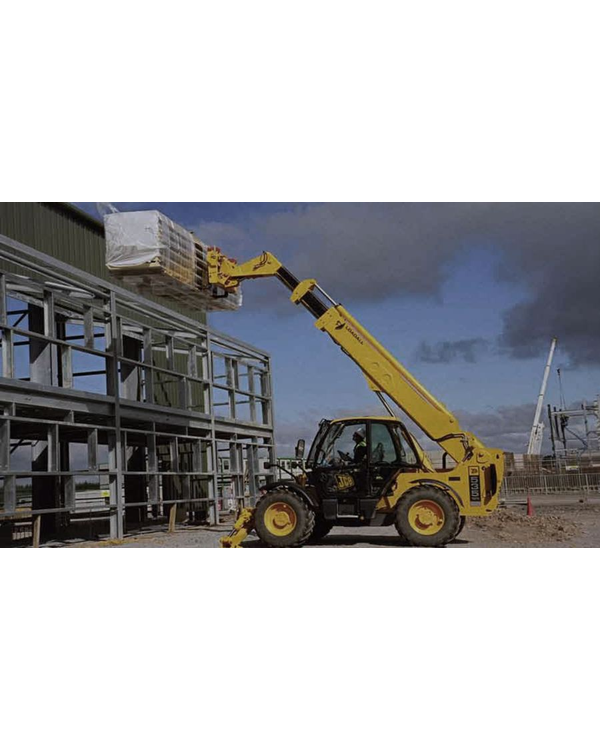
A telehandler's reach is its value — and its risk. Every foot of boom extension reduces safe capacity.

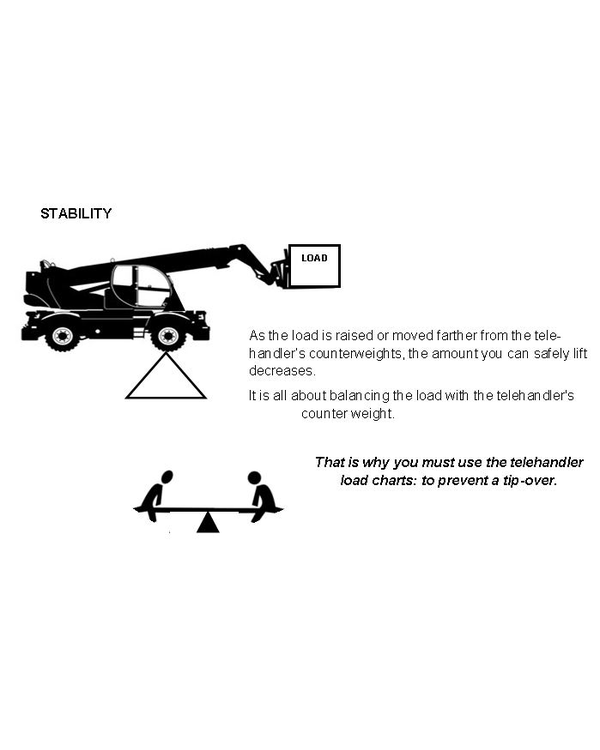
stability is a seesaw — the load balances against the counterweight, and the load chart is the referee.

OSHA compliance services Houston

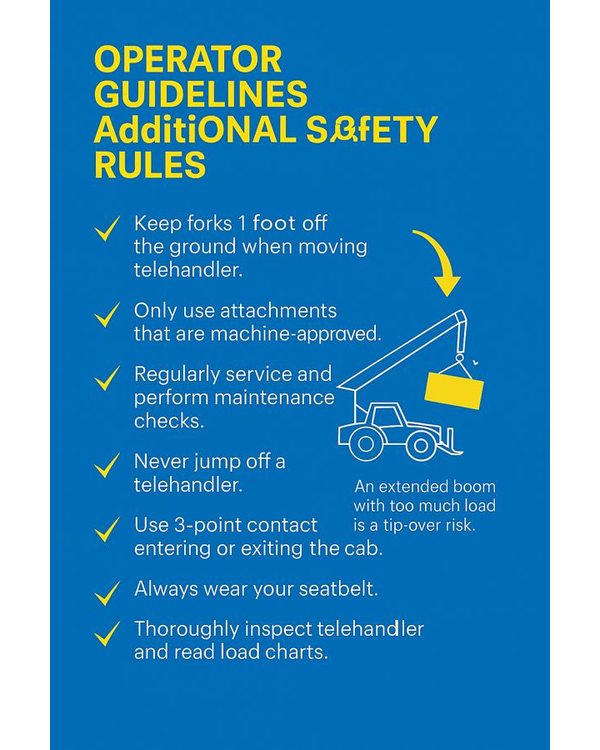
field rules — forks 1 ft off the ground when moving, 3-point contact, seat belt always, never jump off.

Why Train With Aggie Safety

Benefits of Training with Aggie Safety

Fastest path to compliance
15–20 minutes covers the formal instruction OSHA requires — your crew is quiz-passed and certificate-printed the same day.
Increase safety
Operators learn load chart discipline and the stability triangle — the knowledge that prevents the tip-overs that kill.
Ensure compliance
Documented training per 1910.178(l), valid 3 years, with employer evaluation completing the OSHA requirement.
Reduce costs
Tip-overs total machines and injure crews. Load-chart-literate operators protect both.
Bulk discounts
Certifying a whole crew? Bulk training discounts make team compliance affordable.
Your Credential

Certification Valid for 3 Years — Like Your Forklift Card

OSHA treats telehandlers as powered industrial trucks, so certification follows the familiar forklift structure: formal instruction and written evaluation (this course), then a practical evaluation by your employer or trainer on the machine you'll operate. Re-evaluation is required at least every three years.

Pass the quiz and print your Certification of Completion immediately — proof for your employer that the classroom and written test requirements are met.

  • Certificate of Completion — downloadable and printable immediately
  • Valid per OSHA requirements for 3 years
  • Documentation for your employer's 1910.178 training file
  • Free quiz retakes until you pass
OSHA forklift certification online completion

Frequently Asked questions

Is a telehandler certification the same as a forklift certification?
They fall under the same OSHA standard — 29 CFR 1910.178 — but a telehandler is a Class 7 rough terrain forklift, and OSHA requires training on the class of truck you actually operate. A warehouse forklift card does not cover telehandler operation; this course provides the Class 7-specific training.
How long is telehandler certification valid?
Three years. OSHA requires operator re-evaluation at least every three years, with refresher training sooner after an accident, a near-miss, observed unsafe operation, or a change in equipment or workplace conditions.
What is the stability triangle?
The stability triangle is the zone formed by the two front tires and the rear axle pivot — as long as the machine's center of gravity stays inside it, the telehandler is stable. Lifting a load, extending the boom, stopping suddenly, hitting a bump, or carrying an unbalanced load all move the center of gravity; if it leaves the triangle, the machine tips.
Why can't a 10,000 lb telehandler always lift 10,000 lbs?
Because the boom acts as a lever: extending it moves the load farther from the counterweight, shifting the center of gravity forward and reducing safe capacity dramatically. The load chart on the instrument panel shows the actual safe load for each boom angle and extension — reading it before every lift is the core skill of telehandler operation.
Do I still need hands-on evaluation after this course?
Yes. OSHA's powered industrial truck standard requires a practical evaluation on the machine you will operate, performed by your employer or a qualified trainer, in addition to the formal instruction and written evaluation this course provides. That combination completes your certification.
How long is the course?
Most students complete the course in the typical duration listed above. You can start and stop whenever it is convenient — your progress is saved, and there is no time limit to finish.
If I fail the test, do I have to pay to take it again?
No. You may retake the test as many times as you need to pass at no additional charge.
Is your course approved by OSHA?
OSHA does not formally approve any training company or material — it publishes the requirements training must cover. Our silica training course is built to meet and exceed those OSHA training requirements.
How quickly do I get proof of completion?
Immediately. As soon as you pass the online test, you can download and print your personalized Certificate of Completion to show your employer.
Do you offer refunds?
Yes. If you purchased within the last 5 days, have not completed the course, and have not generated your certificate, you are eligible for a full refund — no questions asked. Contact our support team at info@lonestar-losscontrol.com with your order details.
Where is the certificate accepted?
The certificate is accepted in all U.S. states, and in any country that follows OSHA-based requirements, including Canada and Mexico.
Aggie Safety Logo
Your safety partner in OSHA compliance and workforce protection.
  • 6001 Savoy Dr Suite #201B, Houston, TX 77036, USA
  • 8AM – 5PM Monday – Friday
© 2026 Aggie Safety | All Rights Reserved.