
$49.95
• ~45 minutes • English & Spanish • Instant printable certificate
Complete the online course at your own pace, pass the written test, and download your Certificate of Completion immediately.
STEP 1
STEP 2
STEP 3
A rough terrain crane is a physics problem on wheels: boom angle, load radius, counterweight, outrigger footing, wind, and ground bearing capacity all interact on every lift. Wet clay bears less than 10 tons per square meter; hard rock bears 200. An operator who cannot read a load chart or evaluate ground conditions is one over-extended boom away from a tip-over.
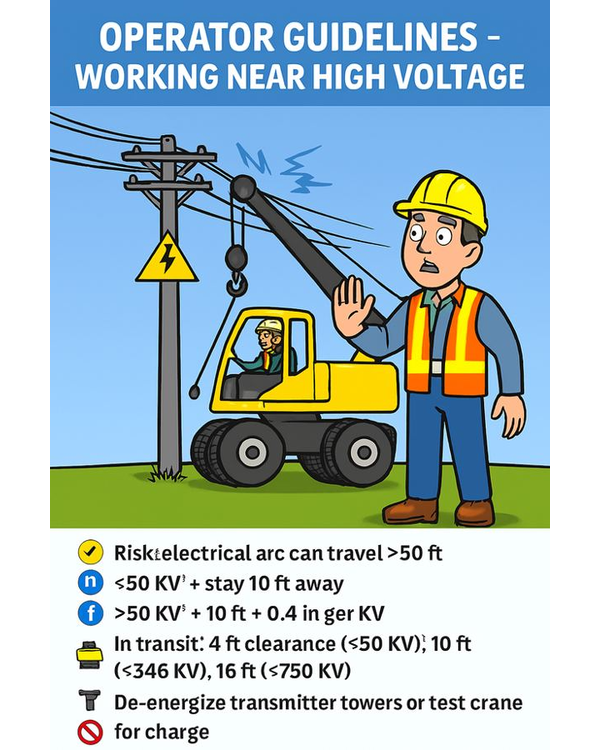
The leading killer in crane work is not collapse — it's electrocution. Roughly a third of crane fatalities involve contact with overhead power lines, which is why OSHA's crane standard (29 CFR 1926 Subpart CC) sets hard clearance distances: 10 feet minimum up to 50 kV, increasing with voltage, and specific in-transit clearances. Our course drills these numbers and the contact procedures that save lives when the worst happens.
The course also covers what most crane incidents trace back to: rigging. Sling inspection, hitch types and their capacity reductions, sling angles, shackles, and eye bolts — a 1/4-inch cut in a sling removes a third of its capacity, and a choker hitch gives up 25% before the lift even starts.

Three tables from the course that answer the three questions every lift starts with: will the ground hold, how close are the lines, and will the rigging carry it?
| Ground Type | Approximate Bearing Capacity |
|---|---|
| Hard rock | 200 tons/m² — most stable |
| Shale / sandstone | 80 tons/m² |
| Compacted gravel | 40 tons/m² |
| Asphalt, compacted sand, stiff dry clay | 20 tons/m² |
| Soft clay or loose sand | 10 tons/m² |
| Wet clay | under 10 tons/m² — unsafe without engineered support |
| Power Line Situation | Minimum Clearance |
|---|---|
| Operating, up to 50 kV | 10 ft |
| Operating, over 50 kV | 10 ft + 0.4 in per kV above 50 |
| In transit, under 50 kV | 4 ft |
| In transit, up to 345 kV | 10 ft |
| In transit, up to 750 kV | 16 ft |
| Sling Damage / Configuration | Capacity Effect |
|---|---|
| 1/8" cut in a sling | −27% capacity |
| 1/4" cut | −32% capacity |
| 3/8" cut | −40% capacity — damaged slings come out of service |
| Choker hitch | −25% vs. vertical rated capacity |
| Sling angle 60° / 45° / 30° | 866 / 707 / 500 lbs on a 1,000-lb basket pair — below 30° is prohibited |
This rough terrain crane training covers the stability, inspection, and rigging fundamentals every operator needs:
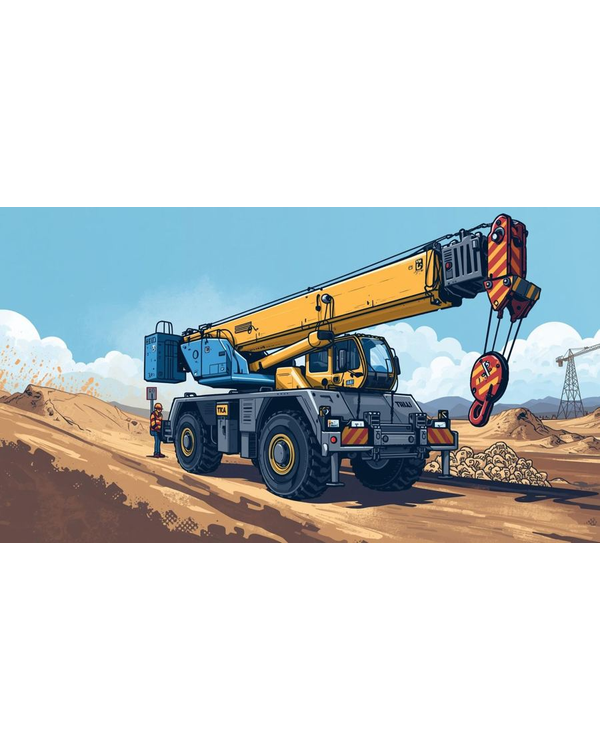
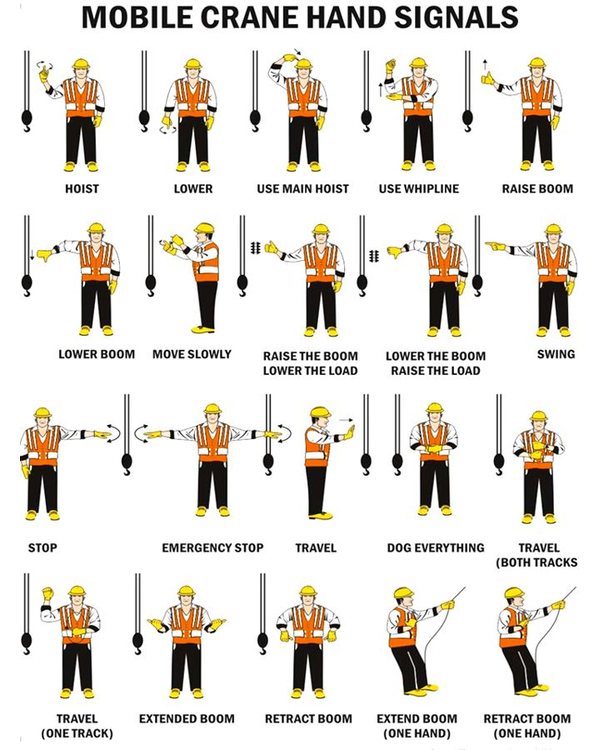
These visuals come directly from the Rough Terrain Crane Training course your team will take — practical, field-tested material, not stock theory.
A large portion of the construction and industrial workforce in Texas is Spanish-speaking. OSHA requires that training be conducted in a language and vocabulary each worker can understand. Aggie Safety delivers the full fall protection course in Spanish — same content, same certificate, same compliance.

