OSHA Compliance & Support | Safety Inspections – Safety Audits | Cost-Effective Safety Consulting

Online Crystalline Silica Safety Training

$24.95

~30 minutes English & Spanish Instant printable certificate

Crystalline silica is in stone, concrete, sand, and brick — 59% of the Earth's crust. Cut it, grind it, drill it, or blast it and the respirable dust that results causes silicosis: a serious, irreversible, sometimes fatal lung disease. OSHA's silica standard limits exposure to 50 micrograms per cubic meter over an 8-hour shift — an amount too small to see. Our online crystalline silica safety training covers the health effects, the controls, and OSHA's Table 1 task-by-task requirements. Typical duration: 30–40 minutes, followed by a quiz.

🫁 Silicosis has no cure — the only treatment is prevention. This training is the prevention.
  • Aligned with OSHA 29 CFR 1926.1153 (construction) and 1910.1053 (general industry)
  • Covers all 18 Table 1 tasks with required controls and respirators
  • Accepted in all states — 100% online course
  • Instant, printable Certificate of Completion
Certify Your Team Today. — Get Crystalline Silica Safety and OSHA Compliant

2.3M

U.S. workers are exposed to respirable crystalline silica on the job — about 2 million in construction
Source: OSHA

50 µg/m³

OSHA's permissible exposure limit (PEL) over an 8-hour shift — 220 times smaller than a grain of sand, invisible to the eye
Source: 29 CFR 1926.1153

0

cures for silicosis — the lung damage is permanent and progressive, which is why exposure control is everything
Source: NIOSH / CDC
The Process

How It Works

Complete the online course at your own pace, pass the quiz, and download your Certificate of Completion immediately.

STEP 1

Enroll & Start Your Online Course

  • Purchase the course and get instant access.
  • No prior crystalline silica experience needed.
  • Learn OSHA safety rules, hazard recognition, and compliance requirements — all online.
  • This online course covers the formal instruction portion.

STEP 2

Complete the Course & Download Your Certificate

  • Study at your own pace and pass the online test.
  • Retake the test as many times as you need at no extra charge.
  • Immediately download and print your Certificate of Completion.

STEP 3

Apply It On Site With Your Competent Person

  • Your employer's written exposure control plan and competent person apply your training to your specific tasks and controls.
  • If you wear a respirator 30+ days per year, your employer offers the required medical surveillance.

The Risk Is Real

Why Crystalline Silica Training Matters

Respirable silica particles are so small they pass the lungs' defenses and scar the air sacs where oxygen enters the blood. The result is silicosis — incurable and progressive — plus elevated risk of lung cancer, chronic bronchitis, kidney disease, and autoimmune disorders including lupus and rheumatoid arthritis. The particles that do this damage are invisible: a full day's legal maximum exposure could not be seen with the naked eye.

OSHA's silica standards — 29 CFR 1926.1153 for construction and 29 CFR 1910.1053 for general industry — set a permissible exposure limit of 50 µg/m³ (8-hour TWA) and an action level of 25 µg/m³. For construction, OSHA's Table 1 lists 18 common tasks — masonry saws, jackhammers, grinders, drills, milling machines, crushing machines, heavy equipment — and specifies the exact engineering controls and respiratory protection for each. Follow Table 1 fully and no exposure monitoring is required; skip it and the burden of proof lands on you.

Employers must also maintain a written exposure control plan, designate a competent person, restrict high-exposure areas, ban dry sweeping and compressed air cleanup where feasible, and offer medical surveillance to workers who wear a respirator 30 or more days per year. This training gives your workers the working knowledge of all of it — the tasks that create silica dust, the controls that capture it, and the habits that keep it out of their lungs.

Where silica exposure happens
  • Grinding, sawing, and drilling concrete or brick
  • Sand blasting paint, rust, and surfaces
  • Cutting cement blocks and mixing mortar or concrete
  • Jackhammering and tunneling through concrete
  • Dry sweeping or compressed-air cleanup of silica dust
  • Milling, crushing, and asphalt work
  • Heavy equipment use in demolition, grading, and excavation
Regulatory note: OSHA notes silica requirements are relatively recent — the current standard took effect less than a decade ago, and enforcement has ramped steadily. Silica citations commonly arrive in multiples: exposure, written plan, training, and medical surveillance violations stack.
Technical Deep Dive

OSHA Table 1 — Task by Task

Table 1 is the practical heart of the silica standard: do the listed controls for your task and exposure monitoring isn't required. Sample rows as taught in the course:

Table 1 Task Required Engineering Control Respirator
Stationary masonry saws Integrated water delivery None
Handheld power saws — outdoors Water feed N95 if used over 4 hrs/shift
Handheld power saws — indoors Water feed N95 always
Jackhammers — outdoors Water feed or shroud + dust collector N95 if over 4 hrs
Jackhammers — indoors Water feed N95 always
Handheld grinders — tuckpointing Shroud + dust collector N95 under 4 hrs, PAPR over 4 hrs
Walk-behind milling / floor grinders Continuous water spray or dust collector None
Crushing machines Water/mist + ventilated booth or remote station None
Heavy equipment — demolition, grading Enclosed cab, or water/dust suppressants None

How small is the PEL? 50 µg is about 220× smaller than a grain of sand. A cubic meter is a box roughly 3 ft 3 in on each side; a worker breathes about 16.8 of those boxes in an 8-hour shift — and even maximum legal exposure is invisible to the naked eye. That is why controls, not eyesight, are the defense.

Course Outline

What You’ll Learn in This Training

This crystalline silica training covers the hazard, the standard, and the task-level controls:

✔ What is crystalline silica — where it occurs and which forms are hazardous
✔ Health effects: silicosis, lung cancer, bronchitis, kidney disease, autoimmune disorders
✔ The tasks that create respirable silica dust
✔ The PEL (50 µg/m³) and action level (25 µg/m³) — and what they mean in practice
✔ Engineering controls: water delivery, vacuum dust collection, ventilation, enclosed cabs
✔ Administrative controls: exposure time limits, restricted areas, medical exams
✔ The competent person role under the silica standard
✔ OSHA Table 1: all 18 tasks with required controls and respirator triggers
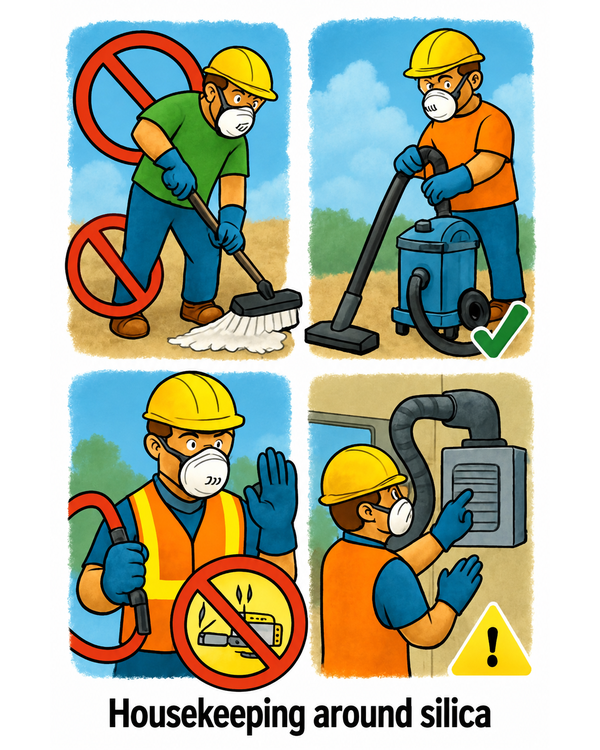
✔ Housekeeping rules: wet sweeping and HEPA vacuums — never dry sweeping or compressed air
✔ When respirators are required — N95 and better, and the 4-hour threshold
✔ Required PPE and hygiene: washable clothing, no eating/drinking/smoking in dust areas
✔ Exemptions: when exposures stay below 25 µg/m³
✔ The written exposure control plan
✔ Medical surveillance: baseline exams, chest X-rays, spirometry, and the 30-day respirator trigger
✔ ONLINE QUIZ

Inside The Course

Straight From the Training Material

These visuals come directly from the Excavator Training course your team will take — practical, field-tested material, not stock theory.
OSHA compliance services Houston

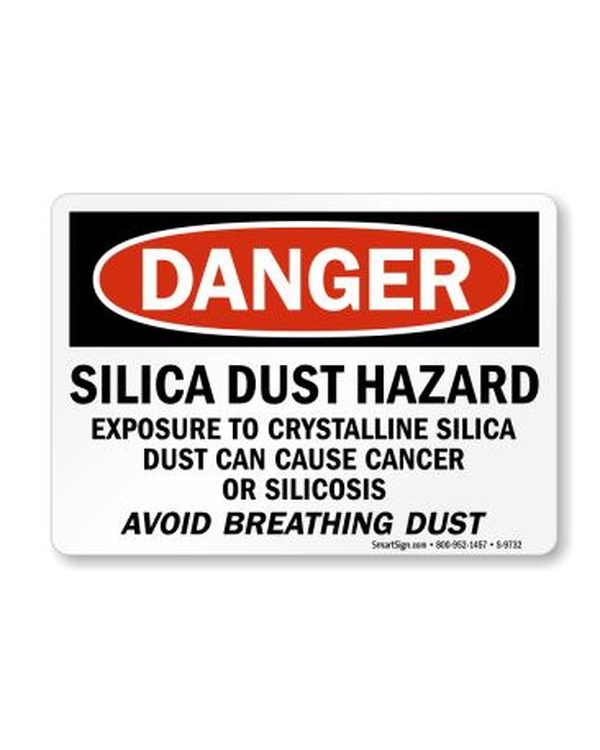
Respirable silica dust causes silicosis and cancer — the warning belongs wherever concrete, stone, or masonry is cut.

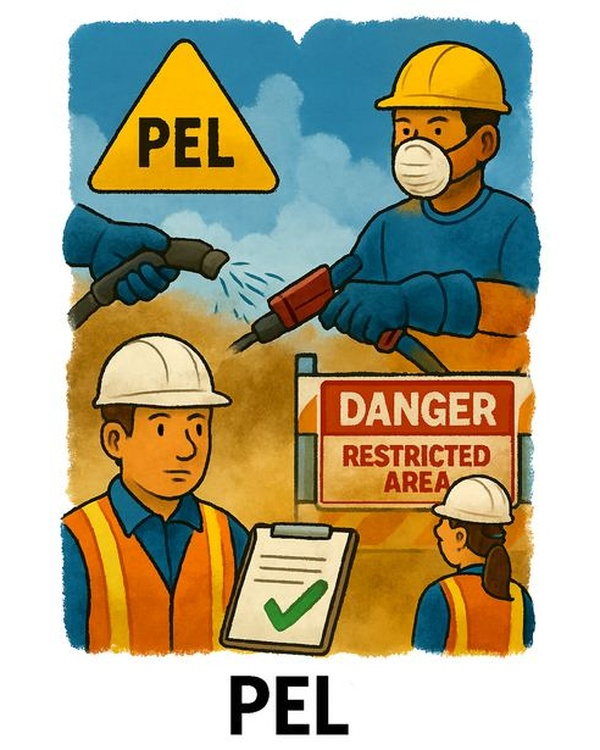
the PEL in practice — restricted areas keep unprotected workers out of high-exposure zones.

OSHA compliance services Houston

safe entry — ladders extend 3–4 ft above the lip, never jump in, keep spoil at least 2 ft from the edge.

Why Train With Aggie Safety

Benefits of Training with Aggie Safety

Prevent incurable disease
Silicosis cannot be treated, only prevented. Trained workers run the controls that keep dust out of lungs.
Ensure compliance
Employee training is an explicit requirement of the silica standard — this course documents it with a same-day certificate.
Master Table 1
Workers learn the exact control and respirator requirement for each of the 18 specified tasks — the practical core of the standard.
Reduce citations
Silica violations stack quickly. Trained crews close the training citation and run the controls that prevent the exposure citation.
Fast and practical
30–40 minutes online, quiz included, certificate printed the same day.
Your Credential

Training That Meets a Modern Standard

The silica standard is one of OSHA's newest major health standards, and it is explicit: employees exposed at or above the action level must be trained on the health hazards, the tasks that produce exposure, the controls in use, the written exposure control plan, and the medical surveillance program.

This course covers every one of those elements. Pass the quiz and print your Certificate of Completion immediately — documentation for your employer's silica program file.

  • Certificate of Completion — downloadable and printable immediately
  • Covers all training elements of 29 CFR 1926.1153(i)
  • Documentation for your employer's exposure control plan
  • Free quiz retakes until you pass
OSHA forklift certification online completion

Frequently Asked questions

What is OSHA's exposure limit for crystalline silica?
The permissible exposure limit (PEL) is 50 micrograms of respirable crystalline silica per cubic meter of air (50 µg/m³), averaged over an 8-hour shift, with an action level of 25 µg/m³ that triggers exposure assessment and medical surveillance obligations. For scale, 50 µg is roughly 220 times smaller than a grain of sand — the legal maximum is invisible.
What is OSHA Table 1?
Table 1 is the construction silica standard's list of 18 common tasks — masonry saws, handheld and walk-behind saws, drills, jackhammers, grinders, milling machines, crushers, and heavy equipment — with the specific engineering controls and respiratory protection required for each. Employers who implement Table 1 fully for a task are not required to conduct exposure monitoring for it.
Is silicosis curable?
No. Silicosis is an irreversible, progressive scarring of the lungs, and no treatment reverses it — management focuses on slowing progression and treating complications. That is why the silica standard is built entirely around preventing exposure through controls, work practices, and respiratory protection.
When do silica-exposed workers need medical exams?
When they are required to wear a respirator 30 or more days per year under the silica standard. The employer must offer a baseline exam within 30 days of assignment — medical and work history, a lung-focused physical, a chest X-ray read by a NIOSH-certified B Reader, spirometry by a certified technician, and a TB test — repeated every three years, at no cost to the employee.
Why is dry sweeping prohibited around silica dust?
Because dry sweeping and compressed air resuspend settled silica dust into the breathing zone, creating exposure from material that was already safely on the ground. The standard requires wet sweeping or HEPA-filtered vacuuming instead, with compressed air allowed only where its dust is captured by ventilation or no other method is feasible.
How long is the course?
Most students complete the course in the typical duration listed above. You can start and stop whenever it is convenient — your progress is saved, and there is no time limit to finish.
If I fail the test, do I have to pay to take it again?
No. You may retake the test as many times as you need to pass at no additional charge.
Is your course approved by OSHA?
OSHA does not formally approve any training company or material — it publishes the requirements training must cover. Our silica training course is built to meet and exceed those OSHA training requirements.
How quickly do I get proof of completion?
Immediately. As soon as you pass the online test, you can download and print your personalized Certificate of Completion to show your employer.
Do you offer refunds?
Yes. If you purchased within the last 5 days, have not completed the course, and have not generated your certificate, you are eligible for a full refund — no questions asked. Contact our support team at info@lonestar-losscontrol.com with your order details.
Where is the certificate accepted?
The certificate is accepted in all U.S. states, and in any country that follows OSHA-based requirements, including Canada and Mexico.
Aggie Safety Logo
Your safety partner in OSHA compliance and workforce protection.
  • 6001 Savoy Dr Suite #201B, Houston, TX 77036, USA
  • 8AM – 5PM Monday – Friday
© 2026 Aggie Safety | All Rights Reserved.