
$24.95
• ~30 minutes • English & Spanish • Instant printable certificate
Complete the online course at your own pace, pass the quiz, and download your Certificate of Completion immediately.
STEP 1
STEP 2
STEP 3
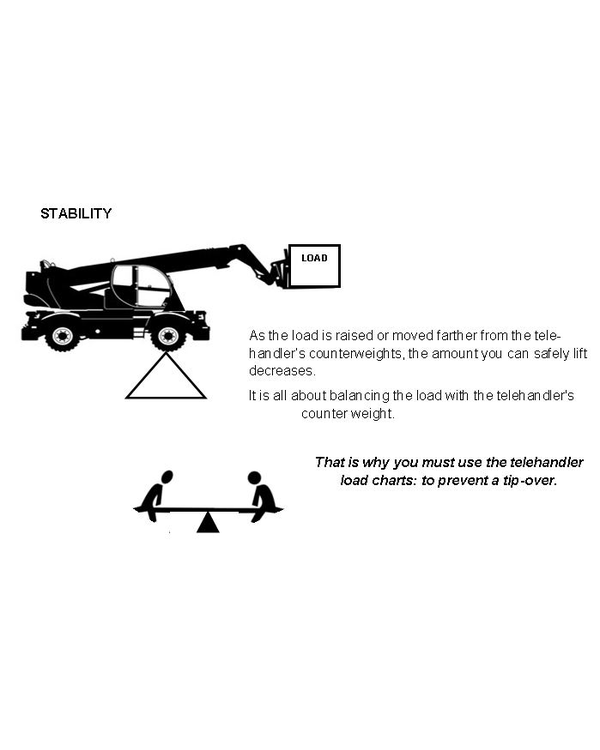
A telehandler is a forklift with a telescoping boom — and the boom changes everything. Extending it moves the load away from the counterweight, shrinking safe capacity with every foot of reach: a 10,000-pound-rated machine cannot lift anywhere near 10,000 pounds at full extension. Operators who don't read load charts discover this by tipping over.
OSHA classifies telehandlers as Class 7 rough terrain forklifts under 29 CFR 1910.178. That standard requires formal instruction, a written evaluation, a practical evaluation on the actual machine, and re-evaluation at least every three years — the same framework as warehouse forklifts, applied to a machine that works on slopes, soft soil, and construction sites.
This telehandler course teaches the stability triangle and the moving center of gravity, how boom angle and extension set safe capacity, ground conditions that swallow outriggers, power line clearances, and the pre-use inspection that catches problems while they're still cheap. It's built for field reality: bulky loads that act like sails, rooftop placements, and rough terrain.
The load chart on the instrument panel is the single most important document on the machine. Here is how the course teaches it.
| Load Chart Concept | What It Means at the Controls |
|---|---|
| Rated capacity | The maximum the machine lifts under specified conditions — boom low and retracted, firm level ground |
| Boom extension | The boom is a lever: extending it moves the CG forward and cuts capacity — a 10,000-lb machine cannot lift 10,000 lbs extended |
| Boom angle | Course example: boom extended 20 ft at a 40% angle → safe capacity ≈ 2,000 lbs |
| "HEAVY" line | Chart region of non-practical working loads — stay below it |
| Load Moment Indicator (LMI) | Electronic monitor that warns when height, weight, and boom angle combine unsafely |
| Field Rule | Number from the Course |
|---|---|
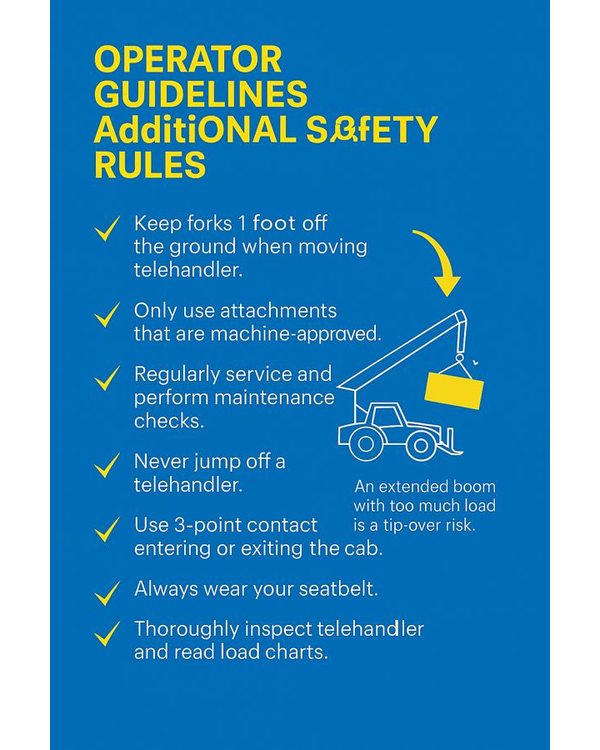
| Load height while traveling | 1 to 1.5 ft off the ground, boom retracted |
| Travel speed with a load | ~3 MPH — walking speed |
| Power line clearance | Minimum 10 ft for low-voltage lines; very high voltage transmission lines can require up to 45 ft |
| Machine weight | Telehandlers can exceed 25,000 lbs — inspect the travel path before driving it |
| Tip-over response | Stay seated, hold firm, lean away from impact — never jump clear |
This OSHA-compliant telehandler course covers Class 7 operation from stability to inspection:
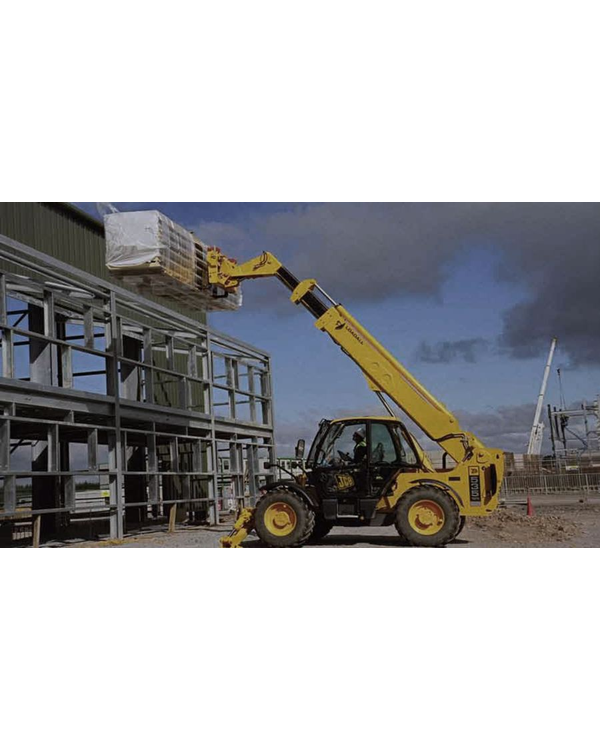
These visuals come directly from the Telehandler Training course your team will take — practical, field-tested material, not stock theory.
OSHA treats telehandlers as powered industrial trucks, so certification follows the familiar forklift structure: formal instruction and written evaluation (this course), then a practical evaluation by your employer or trainer on the machine you'll operate. Re-evaluation is required at least every three years.
Pass the quiz and print your Certification of Completion immediately — proof for your employer that the classroom and written test requirements are met.

