
$24.95
• Under 30 minutes • Online test • Instant Printable Certificate
STEP 1
STEP 2
STEP 3
OSHA defines an affected employee as anyone who operates or uses a machine being serviced under lockout/tagout, or who works in an area where LOTO is being performed. In practice: machine operators, production and line workers, warehouse staff near conveyors and dock equipment, and anyone whose work is interrupted when an authorized employee locks out a machine.
Affected employees do not apply or remove locks — that is the authorized employee's job — but they must recognize LOTO devices, understand why the equipment is down, and know the rules below cold.

The course is built around three real incidents, each one a working answer to “why does this rule exist?”
An employee reached into a board-stacking machine to clear a jammed board. The metal carriage moved unexpectedly, striking him and causing crushing injuries he later died from. The equipment was never locked out before the jam was cleared. Lesson taught: always apply LOTO before clearing jams — never put any part of your body into equipment without energy isolation.
A maintenance technician began work on a hydraulic press after electrical power was disconnected and the work order approved. The ram moved downward anyway — stored hydraulic and gravitational energy was never controlled, and no blocking devices were installed under the ram. His hand was crushed between components. Lesson taught: disconnecting power alone does not control all hazardous energy; moving parts must be physically blocked.
Two experienced, long-term employees were changing blades on a cutting machine in New York when a coworker activated the wrong power switch. The machine powered on and the employee performing maintenance was killed. The power source was never locked and tagged. Lesson taught: experience and verbal coordination do not replace LOTO — only the servicing employee's own lock keeps exclusive control of the energy.
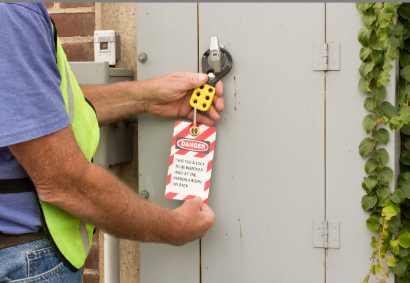
an authorized employee applies the lock and tag — affected employees recognize it and leave it alone.
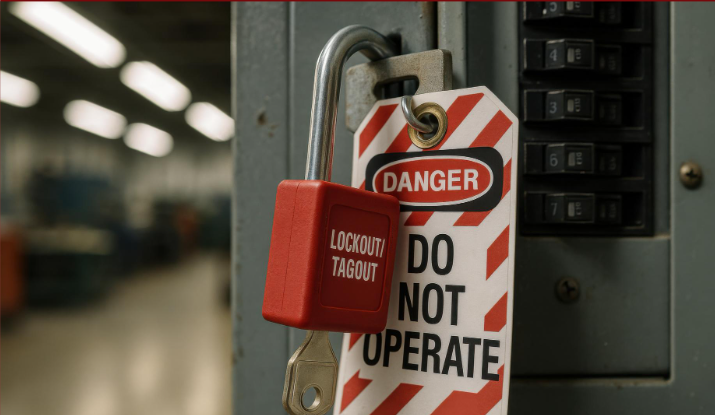
a DANGER — DO NOT OPERATE lockout on a breaker panel. This is what you never remove and never bypass.
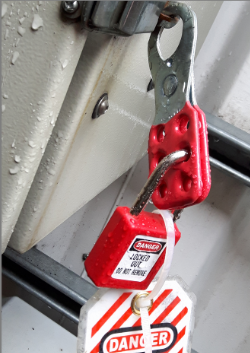
Affected employees don't install these devices, but the course teaches you to recognize each one in the field: wall switch lockouts that trap a switch in the OFF position, breaker lockouts that clamp over single, double, and triple-pole breakers, electrical cut-off lockouts with hasps and padlocks, and valve lockouts — clamshell doors and cable devices — on water, steam, and gas lines.
A device plus a warning tag means the machine is out of service, with the reason, date, and contact on the tag.
An authorized employee applies the lock and tag — affected employees recognize it and leave it alone.
Under OSHA 29 CFR 1910.147(c)(7)(iii), affected employees must receive retraining when job assignments change, new equipment or processes introduce hazards, energy control procedures change, or deficiencies in employee knowledge are identified. OSHA does not mandate a fixed annual renewal period. Retraining is required when changes or deficiencies make it necessary to maintain employee understanding of lockout/tagout safety procedures.

