
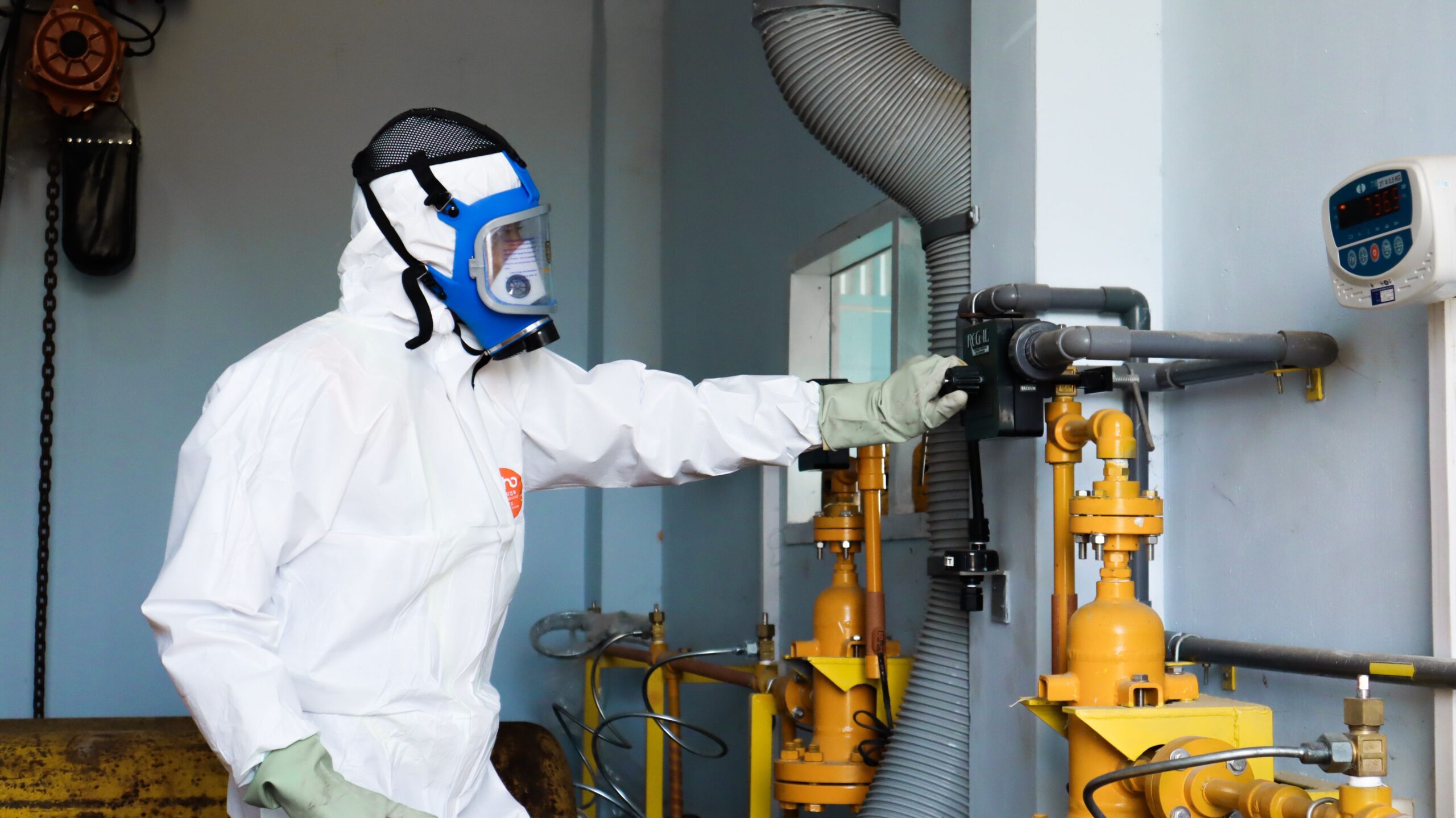
PHA is a required PSM/RMP element (29 CFR 1910.119(e), 40 CFR 68.67) and must be revalidated every five years.
Methodology selection matters: HAZOP, What-If, FMEA, and Checklist each serve different process types and risk profiles. Aggie Safety selects and facilitates the right one for your facility.
LOPA (Layer of Protection Analysis) quantifies risk reduction from independent protection layers — bridging the gap between a qualitative HAZOP and a full quantitative risk assessment.
Facility Siting studies evaluate whether occupied buildings near process hazards are adequately protected from blast, fire, and toxic release scenarios.
Quantitative Risk Assessment (QRA) using PHAST, ALOHA, and SAFETI software allows Aggie Safety to model toxic, flammable, and explosion consequences -- and go further to produce individual risk contours and societal risk curves that support RMP submittals, facility siting, emergency planning, and land-use decisions.
Root Cause Analysis (RCA) applied after incidents or near-misses prevents recurrence by identifying systemic failures, not just the triggering event.
Aggie Safety delivers the full spectrum of PHA and process risk services. Each study is scoped to the specific methodology, process type, and regulatory context your facility requires. Below is what each service covers and when it applies.
A Hazard and Operability Study (HAZOP) is the most rigorous and widely used PHA methodology for continuous process systems — pipelines, reactors, distillation columns, heat exchangers, and similar equipment. It uses a structured set of guidewords (No, More, Less, Reverse, Other Than, As Well As, Part Of) applied systematically to each node of the process to generate deviation scenarios.
Aggie Safety facilitates HAZOPs using up-to-date P&IDs, operating procedures, and process safety information. Our team brings working process knowledge to the table — not just facilitation mechanics. For a HAZOP to produce actionable findings, the facilitator needs to understand the chemistry and thermodynamics well enough to recognize which deviations are credible and which consequences are realistic. That is what 20-plus years of process engineering experience provides.
HAZOP outputs include: identified hazards and consequences, existing safeguards, identified gaps, and recommendations with assigned owners and due dates — formatted to satisfy PSM/RMP documentation requirements and internal insurance audits.
Applicable standards: OSHA 29 CFR 1910.119(e), 40 CFR 68.67 (RMP), IEC 61882 (HAZOP standard), API RP 14C (for offshore/onshore gas facilities).
What-If analysis is a structured brainstorming method that asks "What if this specific deviation or failure occurred?" across defined areas of a process. It is less rigorous than a full HAZOP but faster and well-suited for batch processes, simpler operations, facilities with limited P&ID documentation, or initial-phase hazard screening before detailed engineering is complete.
Aggie Safety conducts What-If studies as standalone engagements or as part of a combined PHA approach where some process sections warrant HAZOP depth and others are adequately addressed with What-If. We document all scenarios, consequences, existing safeguards, and recommendations in a format that meets PSM/RMP requirements.
What-If is also commonly used for Management of Change (MOC) reviews when a process modification is too significant for a simple checklist but does not justify a full node-by-node HAZOP.
LOPA is a semi-quantitative risk assessment technique applied to high-consequence scenarios identified during a HAZOP or What-If study. Where a HAZOP identifies that a scenario is hazardous and that safeguards exist, LOPA answers the question: are those safeguards sufficient?
The method assigns initiating event frequencies and calculates Independent Protection Layer (IPL) credit for each safeguard -- considering demand rate, probability of failure on demand (PFD), and conditional modifiers -- to determine the mitigated event frequency. That frequency is then compared against a target risk tolerance (typically expressed as a maximum tolerable frequency for fatality scenarios, process demands, or environmental releases).
LOPA results directly drive Safety Instrumented System (SIS) requirements. When LOPA shows that existing layers are insufficient, the gap is typically addressed through a Safety Instrumented Function (SIF) designed to IEC 61511 / ISA 84.00.01, with a specified Safety Integrity Level (SIL). Aggie Safety can scope and support SIL determination as part of the LOPA engagement.
Applicable standards: IEC 61511 / ISA 84.00.01 (SIS), CCPS Layer of Protection Analysis: Simplified Process Risk Assessment, OSHA 29 CFR 1910.119.
Root Cause Analysis is the systematic investigation of an incident, near-miss, or repeated equipment failure to identify the underlying systemic causes -- not just the immediate trigger. OSHA PSM requires incident investigation within 48 hours of an event and documentation of root causes, corrective actions, and communication to affected personnel (29 CFR 1910.119(m)).
Most process incidents are not caused by a single failure. They result from the combination of a physical failure, a procedural gap, and an organizational factor that allowed the failure mode to go undetected or uncorrected. RCA methods used by Aggie Safety include:
RCA deliverables include: timeline of events, identified root and contributing causes, corrective and preventive actions (CAPAs) with owners and due dates, and a lessons-learned summary for communication to affected employees -- formatted to satisfy PSM incident investigation requirements.
A Facility Siting Study evaluates whether occupied structures -- control rooms, administrative buildings, maintenance shops, break rooms -- are located at safe distances from process equipment that could release hazardous energy in an accident scenario. It is a required component of Process Safety Information under PSM (29 CFR 1910.119(d)) and is typically triggered or updated by a PHA, a significant process expansion, or an MOC involving new building construction or occupancy changes.
The primary hazard scenarios evaluated in a facility siting study are:
Aggie Safety conducts facility siting studies using consequence modeling (PHAST, described below) to quantify hazard distances and compares results against accepted risk criteria from API RP 752 (Management of Hazards Associated with Location of Process Plant Permanent Buildings) and API RP 753 (Management of Hazards Associated with Location of Process Plant Portable Buildings).
Where a building is identified as inadequately sited, Aggie Safety provides risk reduction options: relocation, blast-rated construction upgrades, occupancy reduction, or administrative controls to limit personnel exposure during high-hazard operations.
Quantitative Risk Assessment is the highest tier of process risk evaluation -- moving from the qualitative hazard identification of a HAZOP to numerical risk calculation that supports regulatory submittals, facility design, emergency planning, and land-use decisions. Aggie Safety uses three industry-standard software platforms to deliver a complete QRA capability:
PHAST -- Process Hazard Analysis Software Tool (DNV)
PHAST is DNV's industry-standard consequence modeling software, used by major oil companies, chemical manufacturers, and regulators worldwide. Aggie Safety uses PHAST to model the physical consequences of accidental releases -- providing the quantitative foundation for RMP off-site consequence analysis, facility siting, emergency response planning, and LOPA scenario calibration.
PHAST modeling capabilities Aggie Safety delivers:
PHAST output directly supports EPA RMP worst-case and alternative release scenario analysis under 40 CFR Part 68 Subpart B. Aggie Safety uses site-specific meteorological data and realistic failure scenarios -- not generic template runs.
ALOHA -- Areal Locations of Hazardous Atmospheres (EPA/NOAA)
ALOHA is the atmospheric dispersion modeling software developed jointly by the U.S. EPA and NOAA, and is the standard tool used by emergency response planners, Local Emergency Planning Committees (LEPCs), State Emergency Response Commissions (SERCs), and first responders. For facilities with EPA RMP obligations and community notification requirements under EPCRA, ALOHA is often the expected format -- because it is the same tool regulators and emergency planners use.
Aggie Safety uses ALOHA for:
Where PHAST is the stronger tool for complex multiphase releases and fire/explosion modeling, ALOHA is the appropriate platform when the primary deliverable is regulatory documentation or emergency planning in the format first responders expect. Aggie Safety selects the right tool -- or runs both -- based on the study objective.
SAFETI -- Software for the Assessment of Flammable, Explosive and Toxic Impact (DNV)
SAFETI is DNV's platform for full site-level QRA -- the most comprehensive risk assessment tool available for process facilities. Where PHAST models the consequence of a single release scenario, SAFETI integrates all credible accident scenarios at a facility into a single risk framework, producing site-wide individual risk contours and societal risk FN curves.
SAFETI QRA Aggie Safety delivers:
SAFETI is the required QRA tool for COMAH (UK) and Seveso III (EU). In the United States, SAFETI-level QRA is used for EPA RMP Program Level 3 facilities, major LNG and petrochemical projects, insurance and lender risk quantification, land-use planning near major hazard sites, and litigation support where court-admissible risk quantification is required.
When is a QRA required? EPA RMP worst-case and alternative release scenarios (40 CFR Part 68 Subpart B) require consequence analysis -- best produced with PHAST or ALOHA. Facility Siting under API RP 752 requires consequence modeling. LOPA uses QRA-derived frequency inputs for SIL determination. Major hazard facilities near populated areas, international projects subject to IFC Performance Standard 4, and facilities requiring insurance or lender risk quantification all benefit from SAFETI-level QRA. OSHA PSM does not require QRA directly, but facility siting (29 CFR 1910.119(d)) typically requires consequence modeling as supporting documentation.
Software Comparison -- Which Platform for Which Purpose
| Software | Primary Use | Key Outputs | When Aggie Safety Uses It |
|---|---|---|---|
| PHAST (DNV) | Single-scenario consequence modeling | Toxic dispersion (IDLH/ERPG), flammable cloud (LFL), VCE overpressure (1-8 psi), pool/jet fire heat flux, flash fire, BLEVE fireball | EPA RMP off-site consequence; facility siting inputs; LOPA severity calibration |
| ALOHA (EPA/NOAA) | Regulatory dispersion modeling, emergency planning | Threat zone footprints at ERPG/AEGL/IDLH; GIS-overlaid hazard maps; LEPC/SERC-format documentation | RMP alternative release scenarios; LEPC/SERC submittal; emergency response plan development |
| SAFETI (DNV) | Full site-level QRA | Individual risk (IR) contours; societal risk FN curves; ALARP evaluation; risk-based land-use planning | Full QRA for major hazard facilities; land-use planning; insurance/lender quantification; litigation support |
| Methodology | Best Suited For | Key Output | Regulatory Basis |
|---|---|---|---|
| HAZOP | Continuous processes with defined P&IDs: refineries, chemical plants, gas processing units | Deviation scenarios, consequences, safeguards, and recommendations for each process node | OSHA 29 CFR 1910.119(e); 40 CFR 68.67; IEC 61882 |
| What If | Batch processes, simpler operations, MOC reviews, early phase hazard screening | Scenario list with consequences, safeguards, and recommendations | OSHA 29 CFR 1910.119(e); 40 CFR 68.67 |
| LOPA | High consequence scenarios identified in HAZOP/What If needing quantified IPL adequacy assessment | Mitigated event frequency vs. target; SIL requirements for safety instrumented functions | IEC 61511 / ISA 84.00.01; CCPS LOPA guidelines |
| Root Cause Analysis | Post incident or near miss investigation; repeat equipment failures | Root and contributing causes; corrective/preventive actions; lessons learned report | OSHA 29 CFR 1910.119(m); 40 CFR 68.81 |
| Facility Siting | Process expansions, new occupied building placement, PSI documentation, MOC involving occupancy | Hazard distances; building risk assessment; risk reduction recommendations | API RP 752 / 753; OSHA 29 CFR 1910.119(d) |
| PHAST Consequence Modelling | RMP off-site consequence analysis, facility siting, emergency planning, LOPA severity calibration | Toxic/flammable/explosion/fire consequence distances; RMP compliant analysis report | 40 CFR Part 68 Subpart B (RMP); API RP 752 |
| ALOHA Dispersion Modelling | RMP alternative release scenarios, LEPC/SERC emergency planning, first responder documentation | Threat zone footprints at ERPG/AEGL/IDLH; GIS site maps; emergency planning zones | 40 CFR Part 68; EPCRA Section 303; EPA/NOAA RMP guidance |
| SAFETI Full Site QRA | Major hazard facilities requiring numerical risk quantification, land use planning, insurance/lender QRA | Individual risk (IR) contours; societal risk FN curves; ALARP evaluation; risk-based zoning | API RP 752; IFC Performance Standard 4; COMAH/Seveso (international); lender/insurer requirements |
We review your facility type, process descriptions, existing PSM/RMP status, and what triggered the study need — initial PHA, five-year revalidation, MOC, post-incident, or new construction. We confirm the appropriate methodology and estimate study scope.
Aggie Safety reviews your Process Safety Information package: P&IDs, PFDs, cause-and-effect diagrams, equipment datasheets, operating procedures, prior PHA reports, and incident history. We identify gaps in documentation before the study begins — documentation gaps during a PHA session waste expensive facilitated time.
We facilitate structured sessions with your operations, engineering, and maintenance teams. Aggie Safety leads the methodology while your team provides the facility-specific knowledge. Sessions are conducted on-site or remotely depending on scope and preference.
All scenarios, consequences, safeguards, and recommendations are documented in real time. You receive a draft report for review — including a recommendation register with suggested action owners and suggested target completion dates.
Final PHA report is issued following your review comments. Aggie Safety can support ongoing recommendation closure tracking and can assist with PSM documentation updates (P&ID markups, procedure revisions, MOC documentation) arising from the study.

Aggie Safety Certified Engineers Conducting studies have more than 20 years of Experience in Oil & Gas, Petrochemical, Gas Processing and Refining. Team is Led by Sumit Anand, PE. He holds a master's degree in chemical engineering with a research focus in process safety and spent his career at companies including CITGO, KBR, and BASF before founding Aggie Safety's process safety practice. PHA facilitation is only as good as the facilitator's ability to recognize credible scenarios. That comes from having designed, troubleshot, and operated the kinds of systems being analyzed not from running software or reading guideword lists.
PHA findings do not exist in isolation. They connect to PSM program elements: mechanical integrity, operating procedures, MOC, training, and emergency response. Aggie Safety's team holds the full PSM/RMP picture, so recommendations from a PHA are integrated into your compliance program rather than handed off as a disconnected list.
Many Texas PHA consultants can facilitate a HAZOP. Very few can also run PHAST consequence models, generate ALOHA threat zone footprints for LEPC submittals, and deliver SAFETI individual risk contours and FN curves for a full site QRA -- all in a single engagement. Aggie Safety operates all three platforms. This means consequence analysis and risk quantification are conducted by the same team that designed the PHA, using the same process data, without hand-offs between consultants.
A five-year HAZOP revalidation for a small specialty chemical facility looks very different from an initial PHA for a new gas processing unit. We scope every engagement to what your facility actually needs, not a standard package that may be more or less than what the project requires.
On-site PHA facilitation is available throughout Baytown, Pasadena, Deer Park, Texas City, Freeport, and the broader Gulf Coast industrial corridor. For full team credentials, visit our About Us page.
PHA support work we have done in past


