
$44.95
• 1 hour • 70% to pass, free retakes • Instant printable certificate • Accepted nationwide
OSHA requires three components for full aerial lift certification. Aggie Safety delivers Step 1 online — fully and completely. Steps 2 and 3 happen at your workplace.
STEP 1
STEP 2
STEP 3
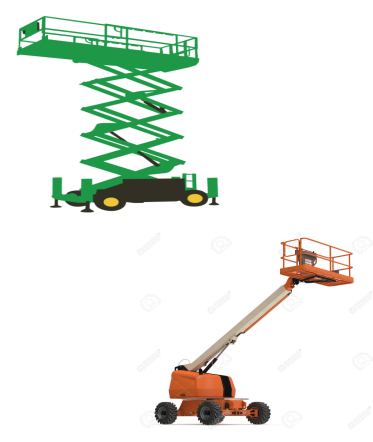
The course opens where accidents actually start: equipment selection. A boom lift is more maneuverable and rises higher; a scissor lift carries more workers and supplies; rough terrain requires a lift designed for it. Fall protection differs by type — on a scissor lift with safety rails in good condition and no missing parts, a harness is not required; on a boom lift, a harness with a restraint lanyard is mandatory, sized short enough to stop you from being thrown over the safety rails. That ejection scenario is why boom lifts use restraint — not shock-absorbing — lanyards.


Every aerial lift has a stability box: as long as the center of gravity stays inside it, the lift is stable; outside it, lateral or longitudinal stability is lost and the lift tips. The course names the four moves that push the CG out of the box: turning too fast, a tire hitting a hole, lifting or turning on an incline, and lifting too heavy a load. This is why the rules exist — never operate or turn with a raised platform on an incline, and never exceed rated load.
The course walks the full daily inspection: tires (air-filled at correct pressure — never operate on a flat; replace any solid tire with a crack across its face to the rim), frame and moving parts for damage or missing parts, safety railing and the fall protection anchor, hydraulic leaks (a pool of fluid under the lift takes it out of service until a mechanic clears it), all controls and outriggers function-tested, the operator's manual physically on the lift, battery secured with tight connections, warning labels readable, and lights, horns, and backup horns working.

When is retraining required? OSHA requires retraining when: (1) an operator is involved in an aerial lift accident or near-miss; (2) a workplace evaluation indicates the operator has not retained required knowledge or skills; (3) the operator is observed operating unsafely; or (4) the employer's policies require periodic renewal.

