OSHA Compliance & Support | Safety Inspections – Safety Audits | Cost-Effective Safety Consulting
For Texas Operations & EHS Teams

Free Aerial, Scissor & Boom Lift Evaluation & Inspection Checklist

Document pre-use inspections and hands-on skills for scissor and boom lifts with one free PDF. The packet records lift type and make/model, observed operating skills, Prior Training Credit and employer authorization.

  • Free for internal workplace use
  • Inspection & operator evaluation
  • 1 printable PDF
  • Rev. 1 – Nov 2026
  • Last updated: November 25, 2026
Free PDF
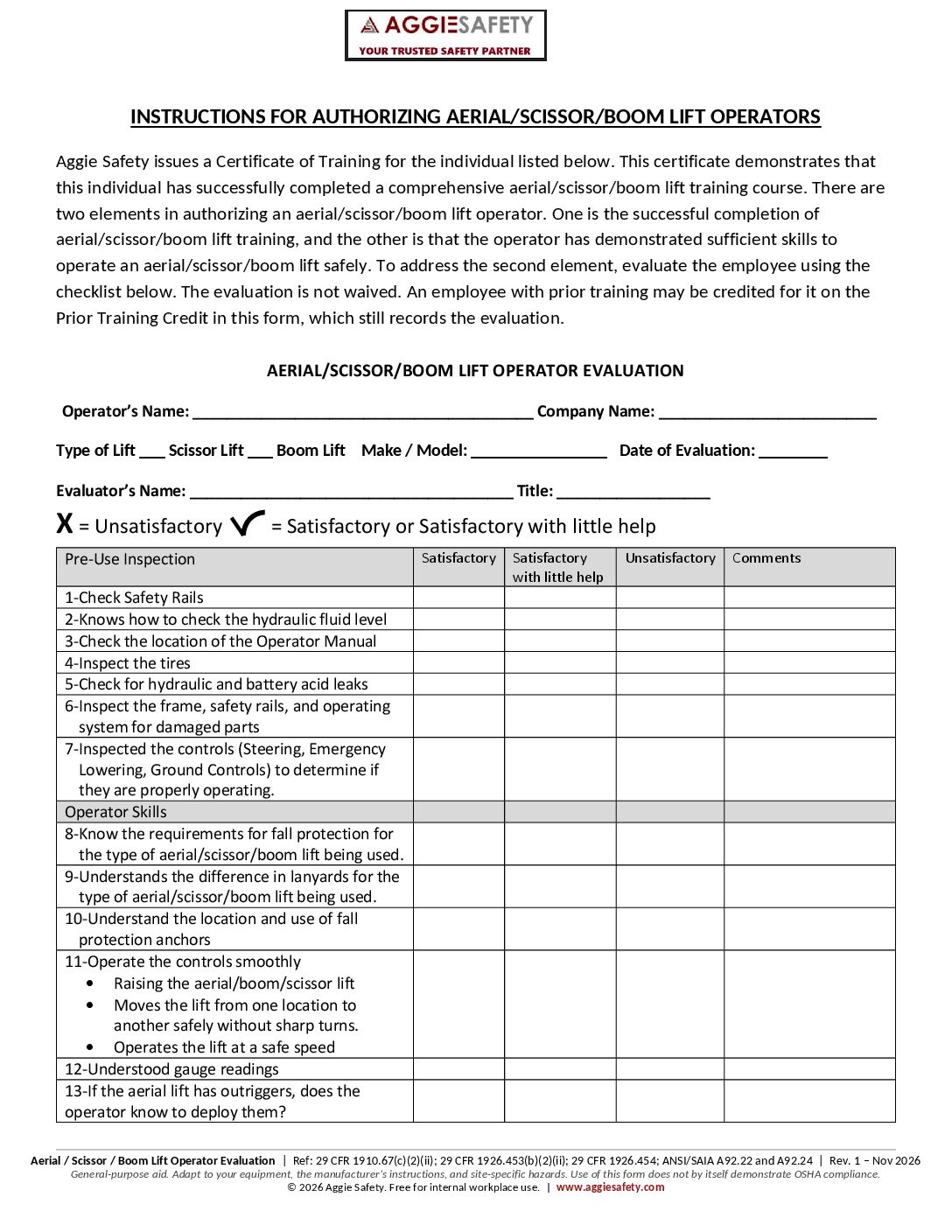
First page of the Aerial / Scissor / Boom Lift Operator Evaluation Checklist
1 Free PDF Packet
EN / ES Online training options
Texas Houston-based support
100+ Years combined experience
Practical Tools for Your Team

Put Consistent Aerial Lift Records in Your Team’s Hands

Give operators, supervisors and safety staff one packet for equipment checks and hands-on evaluations.

First page of the Aerial / Scissor / Boom Lift Operator Evaluation Checklist

Aerial / Scissor / Boom Lift Evaluation & Inspection Checklist

3 pages · Portrait PDF

Use this three-page packet to inspect the lift, record hands-on skills and identify the lift type and make/model. Includes Prior Training Credit, training/evaluation dates and signed employer authorization.

Download Free Checklist
What's Inside

What the Aerial Lift Checklist Covers

Pre-Use: Rails & Structure

  • Safety rails
  • Frame and operating-system damage
  • Tire condition

Pre-Use: Fluids & Leaks

  • Hydraulic fluid level
  • Hydraulic leaks
  • Battery acid leaks

Pre-Use: Manuals & Controls

  • Operator manual location
  • Steering controls
  • Emergency lowering
  • Ground controls

Evaluation: Fall Protection

  • Requirements for the type of lift
  • Lanyard selection
  • Location and use of anchors

Evaluation: Lift Operation

  • Raising the platform smoothly
  • Moving between locations safely
  • Avoiding sharp turns
  • Safe travel speed

Evaluation: Equipment Knowledge

  • Understanding gauge readings
  • Deploying outriggers when fitted
  • Identifying scissor or boom lift type

Evaluation: Written Record

  • Operator, company, lift type and make/model
  • Evaluator name and title
  • Date of evaluation
  • Comments on individual items

Supporting Guidance

  • Hydraulic-level review tips
  • Tire-condition review tips
  • Ground-control observations
  • Lift-specific fall-protection and lanyard review

Documentation Included in the Packet

  • Operator, company, lift type, make/model and evaluator identification
  • Pre-use inspection and hands-on skills evaluation with comments
  • Scissor-/boom-lift employer authorization with training/evaluation dates, trainer/evaluator name, and authorizing signature, title and date
  • Prior Training Credit: employer-reviewed training source/date, workplace evaluation date and evaluator signature. Credit does not waive the evaluation.

How Each Item Is Rated

✔ Satisfactory
✔ Satisfactory with little help
X Unsatisfactory

Document any performance gaps, arrange follow-up training and reassess before employer authorization.

A Consistent Process Across Shifts

Make Aerial Lift Checks Part of Your Team’s Routine

New hires, changing shifts and busy production schedules can leave gaps in records. Use a repeatable workflow that gives operations and EHS clear responsibilities.

Plan Training around Shifts

Schedule formal instruction around production needs. English and Spanish online course options help you coordinate training for a bilingual workforce.

Evaluate in Your Workplace

Have your trainer document hands-on skills on the actual equipment, with attention to the tasks, operating area and hazards at your site.

Keep a Complete Record

Retain the lift type and make/model, training/evaluation dates, evaluator details and signed employer authorization with the operator’s records.

Close the Loop on Defects

Use your equipment inspection and defect-reporting process to flag concerns, document maintenance follow-up and inform the next operator.

Training That Fits Your Workforce

Aerial Lift Training for Busy, Bilingual Teams

Coordinate formal instruction around shift schedules with self-paced online training in English or Spanish. Pair it with workplace practical training, hands-on evaluation and organized records—not as a replacement for them.

  • Covers lift selection, stability, pre-use inspection, fall protection and safe operating practices
  • Certificate of Completion you can print right after passing
  • Free test retakes and no time limit
  • English and Spanish course options for a bilingual workforce
FAQ

Frequently Asked Questions

Does This Checklist Replace Aerial Lift Training?

No. Use it alongside training and equipment-specific familiarization. Prior Training Credit does not waive the workplace evaluation. Record observed skills and employer authorization; a completed form alone does not establish operator qualification or OSHA compliance.

Does the PDF Cover Both Scissor Lifts and Boom Lifts?

Yes. It records scissor-/boom-lift type and the machine’s make/model, with pre-use checks, observed operating skills and lift-specific fall-protection knowledge. Use the manufacturer’s instructions and site-specific procedures for the actual machine.

How Are Operator Skills Rated?

The form uses ✔ for Satisfactory or Satisfactory with little help, and X for Unsatisfactory, with space for comments. Record each observed item, document any gaps and arrange follow-up training and reassessment before employer authorization.

When Should the Lift Be Inspected?

Follow the manufacturer’s inspection schedule and applicable workplace requirements. Use the pre-use section to document the equipment checks relevant to the lift before operation.

Is the Aerial Lift Checklist Free to Use?

Yes. The PDF is free for internal workplace use. Adapt it to your equipment, the manufacturer’s instructions and site-specific hazards.

Can Aggie Safety Support Our Existing EHS Team?

Yes. We work alongside in-house EHS and operations teams—not instead of them. Ask about on-demand safety consulting, independent inspections, training support and specialist engineering help for your facility.

How Can We Train a Bilingual, Rotating Workforce?

Aggie Safety offers English and Spanish online aerial lift courses that operators can work through on their own schedule. Use the checklist to support a consistent inspection and evaluation workflow as employees join or move between shifts.

Does OSHA Require Aerial Lift Operators to Be Trained?

Yes. In general industry, 29 CFR 1910.67(c)(2)(ii) allows only trained persons to operate an aerial lift. In construction, 29 CFR 1926.453(b)(2)(ii) allows only authorized persons to operate one, and 29 CFR 1926.454 sets training requirements for scaffold work, which OSHA applies to scissor lifts. This checklist documents the hands-on evaluation that supports the employer's authorization.

General-purpose aid. Adapt to your equipment, the manufacturer's instructions and site-specific hazards. Use of this form does not by itself demonstrate OSHA compliance. © 2026 Aggie Safety. Free for internal workplace use.

Aggie Safety Logo
Your safety partner in OSHA compliance and workforce protection.
  • 6001 Savoy Dr Suite #201B, Houston, TX 77036, USA
  • 8AM – 5PM Monday – Friday
© 2026 Aggie Safety | All Rights Reserved.