OSHA Compliance & Support | Safety Inspections – Safety Audits | Cost-Effective Safety Consulting
For Texas Operations & EHS Teams

Free Forklift Pre-Shift Inspection & Practical Evaluation Checklists

Give your supervisors a consistent way to document forklift inspections and hands-on evaluations. Built for busy manufacturing and process facilities, these free PDFs help organize records, flag equipment issues and support your existing safety team.

  • Free for internal workplace use
  • Ref: 29 CFR 1910.178
  • 2 printable PDFs
  • Rev. 1 – Nov 2026
  • Last updated: November 25, 2026
Free PDF
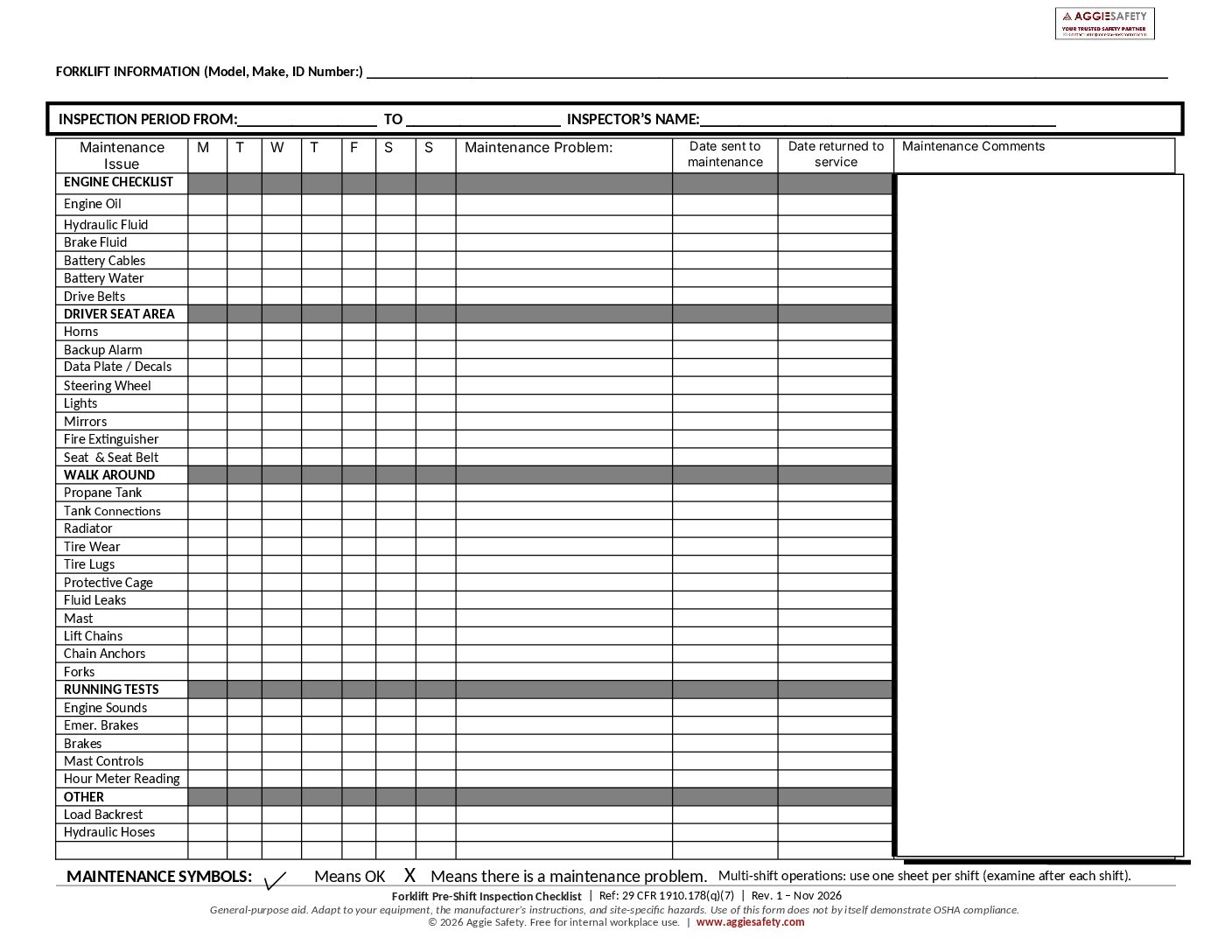
Preview of the Forklift Pre-Shift Inspection Checklist
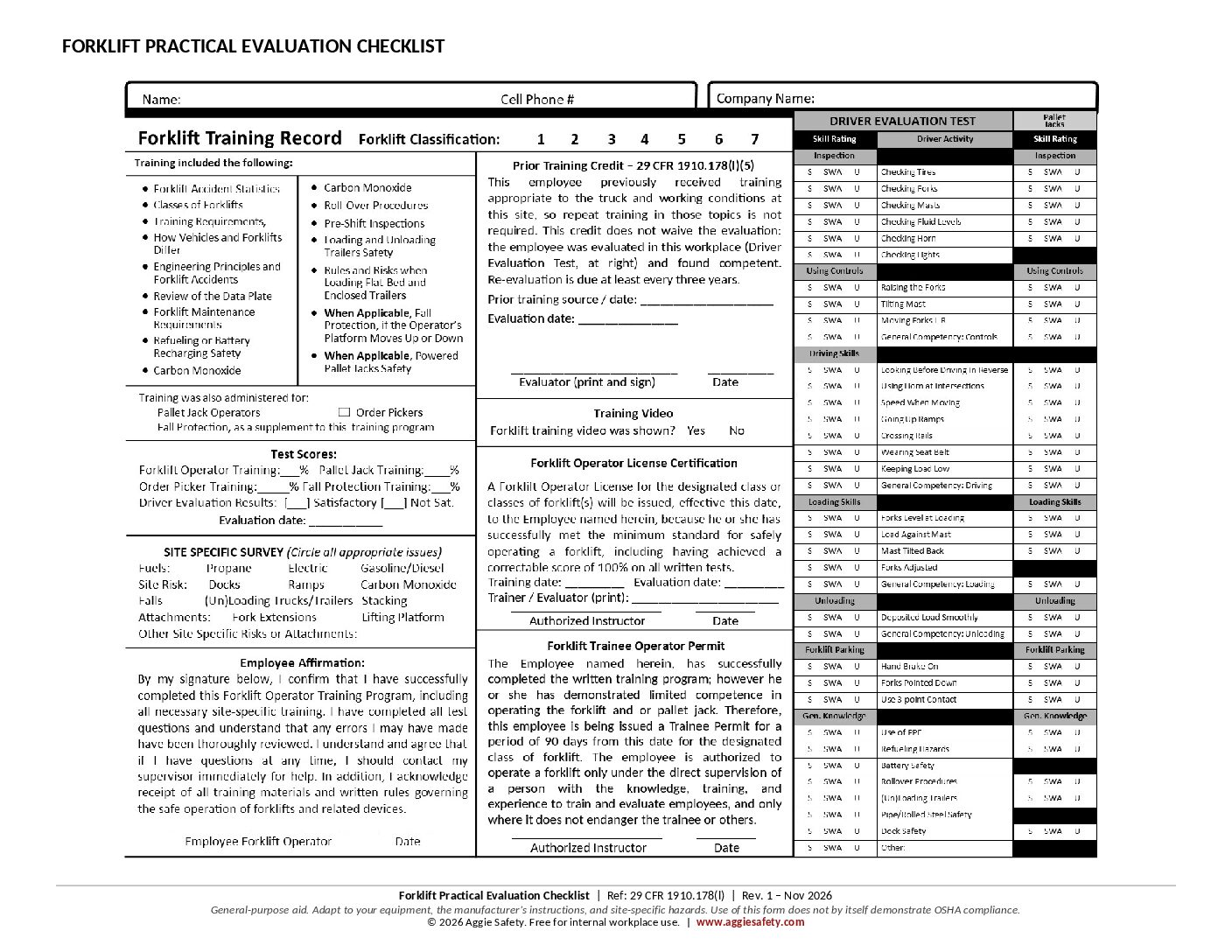
Preview of the Forklift Practical Evaluation Checklist
2 Free PDFs
EN / ES Online training options
Texas Houston-based support
100+ Years combined experience
Practical Tools for Your Team

Put Consistent Forklift Records in Your Team's Hands

Give operators, supervisors and EHS staff the same forms for daily checks and hands-on evaluations.

First page of the Forklift Pre-Shift Inspection Checklist

Forklift Pre-Shift Inspection Checklist

1 page · Landscape PDF · Ref: 29 CFR 1910.178(q)(7)

Keep one weekly inspection log per forklift, or one per shift for multi-shift operations. Record daily checks, flag defects and track maintenance dates so supervisors can follow up without searching through scattered notes.

First page of the Forklift Practical Evaluation Checklist

Forklift Practical Evaluation Checklist

1 page · Landscape PDF · Ref: 29 CFR 1910.178(l)

Give your trainer a consistent record of hands-on skills on the actual equipment. Score forklift and pallet jack tasks separately and keep the completed form with the operator's training records.

What's Inside

What the Forklift Checklists Cover

Pre-Shift: Engine

  • Engine oil
  • Hydraulic fluid
  • Brake fluid
  • Battery cables
  • Battery water
  • Drive belts

Pre-Shift: Driver Seat Area

  • Horn
  • Backup alarm
  • Data plate and decals
  • Steering wheel
  • Lights
  • Mirrors
  • Fire extinguisher
  • Seat and seat belt

Pre-Shift: Walk-Around

  • Propane tank and connections
  • Radiator
  • Tire wear and lugs
  • Protective cage
  • Fluid leaks
  • Mast, lift chains and chain anchors
  • Forks
  • Load backrest
  • Hydraulic hoses

Pre-Shift: Running Tests

  • Engine sounds
  • Emergency brake
  • Brakes
  • Mast controls
  • Hour meter reading

Evaluation: Inspection & Controls

  • Checking tires, forks, mast, fluid levels, horn and lights
  • Raising the forks
  • Tilting the mast
  • Moving forks left and right

Evaluation: Driving Skills

  • Looking before driving in reverse
  • Using the horn at intersections
  • Speed when moving
  • Going up ramps and crossing rails
  • Wearing a seat belt
  • Keeping the load low

Evaluation: Loading & Unloading

  • Forks level at loading
  • Load against the mast
  • Mast tilted back
  • Forks adjusted
  • Depositing the load smoothly

Evaluation: Parking & Knowledge

  • Hand brake on, forks pointed down
  • 3-point contact
  • Use of PPE and refueling hazards
  • Battery safety and rollover procedures
  • (Un)loading trailers, dock and pipe/rolled steel safety

Also on the Practical Evaluation Form

  • Forklift training record with test scores for forklift, pallet jack, order picker and fall protection training
  • Site-specific survey: fuels, site risks (docks, ramps, trailers, carbon monoxide) and attachments
  • Employee affirmation signed by the operator
  • Forklift Operator License Certification with training date, evaluation date and trainer/evaluator name; Prior Training Credit under 29 CFR 1910.178(l)(5), which records the evaluation date and evaluator; and a 90-day Trainee Operator Permit

How Each Item Is Rated

S Satisfactory
SWA Satisfactory with a little assistance
U Unsatisfactory

An operator with an unsatisfactory grade should not be licensed or authorized to operate.

A Consistent Process Across Shifts

Make Forklift Checks Part of the Way Your Team Works

New hires, changing shifts and busy production schedules can leave gaps in records. Use a repeatable workflow that gives operations and EHS clear responsibilities.

Plan Training around Shifts

Schedule formal instruction around production needs. English and Spanish online course options help you coordinate training for a bilingual workforce.

Evaluate in Your Workplace

Have your trainer document hands-on skills on the actual equipment, with attention to the loads, routes and hazards at your facility.

Keep a Complete Record

Keep signed evaluation records with the operator's training documentation, so supervisors and EHS staff can find them when needed.

Close the Loop on Defects

Use the daily inspection log to flag equipment concerns, track maintenance follow-up and give the next shift a clear record.

Training That Fits Your Workforce

Forklift Training for Busy, Bilingual Teams

Coordinate formal instruction around shift schedules with self-paced online training in English or Spanish. Pair it with workplace practical training, hands-on evaluation and organized records—not as a replacement for them.

  • Covers forklift classes, stability, pre-operation inspections, load handling and pedestrian safety
  • Certificate of Completion you can print right after passing
  • Free test retakes and no time limit
  • English and Spanish course options for a bilingual workforce
FAQ

Frequently Asked Questions

Does OSHA Require Forklift Operators to Be Evaluated?

Yes. Under 29 CFR 1910.178(l), operator training combines formal instruction, practical training and an evaluation of the operator's performance in the workplace. The practical evaluation checklist gives your trainer a written record of that hands-on evaluation.

How Often Should the Pre-Shift Inspection Be Done?

29 CFR 1910.178(q)(7) calls for trucks to be examined before being placed in service, at least daily, or after each shift when used around the clock. The checklist has one column per day so a single sheet covers a full week for one truck. Multi-shift operations should use one sheet per shift.

What Do S, SWA and U Mean on the Evaluation?

S is satisfactory, SWA is satisfactory with a little assistance, and U is unsatisfactory. Score the forklift and pallet jack columns separately if the operator uses both.

What If a Truck Fails the Pre-Shift Inspection?

Mark the item with an X, describe the problem, and take the truck out of service. Record the date it was sent to maintenance and the date it returned to service on the same line.

Is the Forklift Checklist Free to Use?

Yes. Both forms are free for internal workplace use. Adapt them to your equipment, the manufacturer's instructions and your site-specific hazards.

Can Aggie Safety Support Our Existing EHS Team?

Yes. We work alongside in-house EHS and operations teams—not instead of them. Ask about on-demand safety consulting, independent inspections, training support and specialist engineering help for your facility.

How Can We Train a Bilingual, Rotating Workforce?

Aggie Safety offers English and Spanish online forklift courses that operators can work through on their own schedule. Use the checklists to support a consistent inspection and evaluation workflow as employees join or move between shifts.

How Often Must Forklift Operators Be Re-Evaluated?

29 CFR 1910.178(l)(4)(iii) requires an evaluation of each operator's performance at least once every three years. Refresher training is also required sooner in certain cases, such as after an accident, a near miss, or an observed unsafe operation.

General-purpose aid. Adapt to your equipment, the manufacturer's instructions and site-specific hazards. Use of this form does not by itself demonstrate OSHA compliance. © 2026 Aggie Safety. Free for internal workplace use.

Aggie Safety Logo
Your safety partner in OSHA compliance and workforce protection.
  • 6001 Savoy Dr Suite #201B, Houston, TX 77036, USA
  • 8AM – 5PM Monday – Friday
© 2026 Aggie Safety | All Rights Reserved.