Does This Checklist Replace Excavator Training?
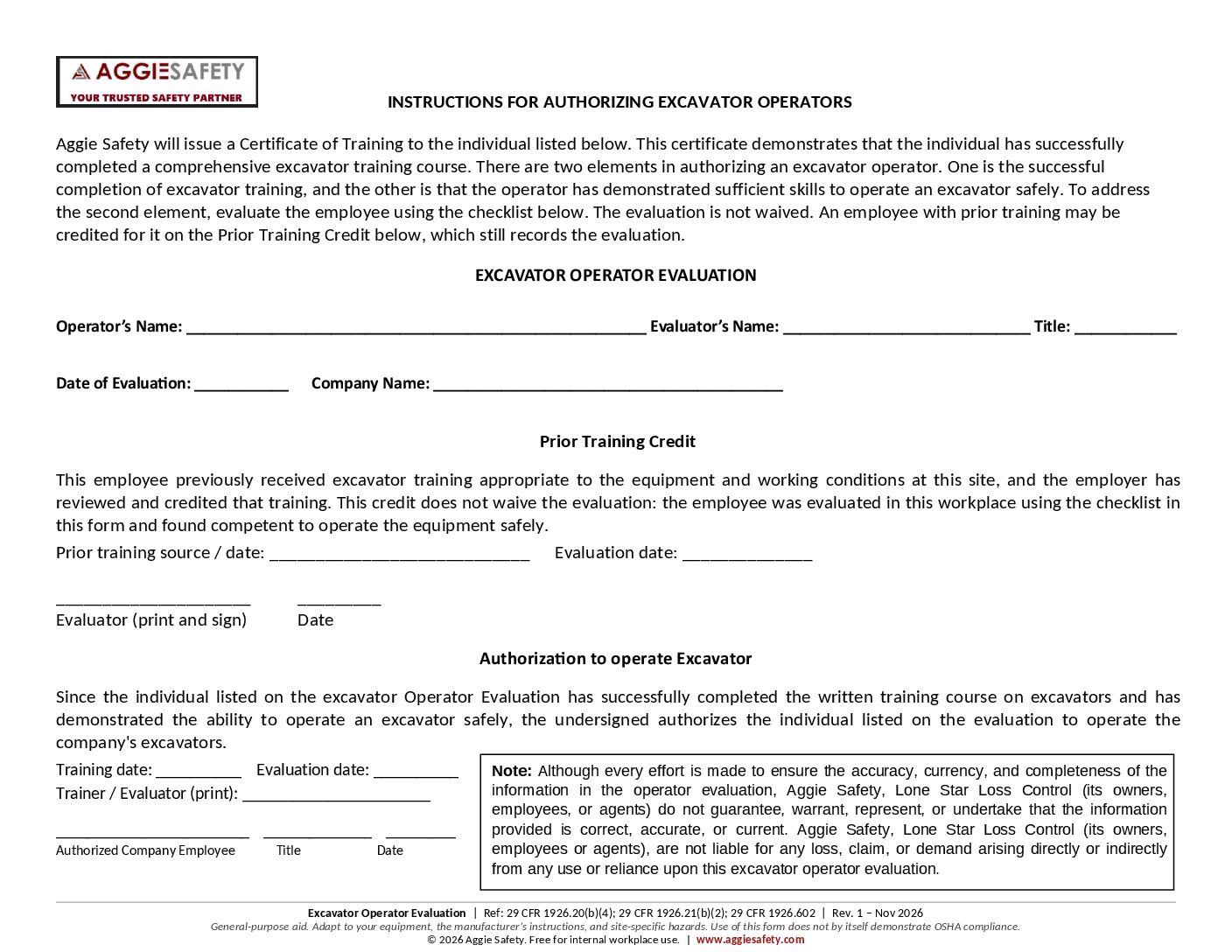
No. Use it alongside formal instruction, practical training and site-specific procedures. Prior Training Credit does not waive the workplace evaluation. The completed form alone does not establish operator competence or demonstrate OSHA compliance.
Can It Be Used for a Mini Excavator?
Use the packet as a starting point, then check every item against the actual machine and operator manual. Excavator designs vary, so add, revise or mark items not applicable as appropriate to your equipment.
How Are Knowledge and Skills Rated?
The form distinguishes adequate knowledge or skill, adequate knowledge or skill with coaching, and insufficient knowledge or skill. Use the evaluator comments to document gaps and follow-up training.
Does It Include Pre-Operational and Shutdown Checks?
Yes. It covers machine condition, cab and safety equipment, operating skills, load handling and shutdown. The shutdown section includes lowering attachments, reporting maintenance concerns and securing the excavator.
Is the Excavator Checklist Free to Use?
Yes. The PDF is free for internal workplace use. Adapt it to your equipment, the manufacturer’s instructions and site-specific hazards.
Can Aggie Safety Support Our Existing EHS Team?
Yes. We work alongside in-house EHS and operations teams—not instead of them. Ask about on-demand safety consulting, independent inspections, training support and specialist engineering help for your facility.
How Can We Train a Bilingual, Rotating Workforce?
Aggie Safety offers English and Spanish online excavator courses that operators can work through on their own schedule. Use the checklist to support a consistent inspection and evaluation workflow as employees join or move between shifts.
Does OSHA Require Excavator Operator Training?
In construction, 29 CFR 1926.20(b)(4) requires employers to permit only employees qualified by training or experience to operate equipment and machinery, and 29 CFR 1926.21(b)(2) requires instruction in recognizing and avoiding unsafe conditions. Training plus a documented evaluation is a practical way to show an operator is qualified.
General-purpose aid. Adapt to your equipment, the manufacturer's instructions and site-specific hazards. Use of this form does not by itself demonstrate OSHA compliance. © 2026 Aggie Safety. Free for internal workplace use.