OSHA Compliance & Support | Safety Inspections – Safety Audits | Cost-Effective Safety Consulting
For Texas Operations & EHS Teams

Free Telehandler Operator Evaluation & Inspection Checklist

Document telehandler pre-use inspections and hands-on operating skills with one free PDF. This three-page packet covers load charts, controls, driving, load placement and parking, plus Prior Training Credit and employer authorization.

  • Free for internal workplace use
  • Inspection & operator evaluation
  • 1 printable PDF
Free PDF
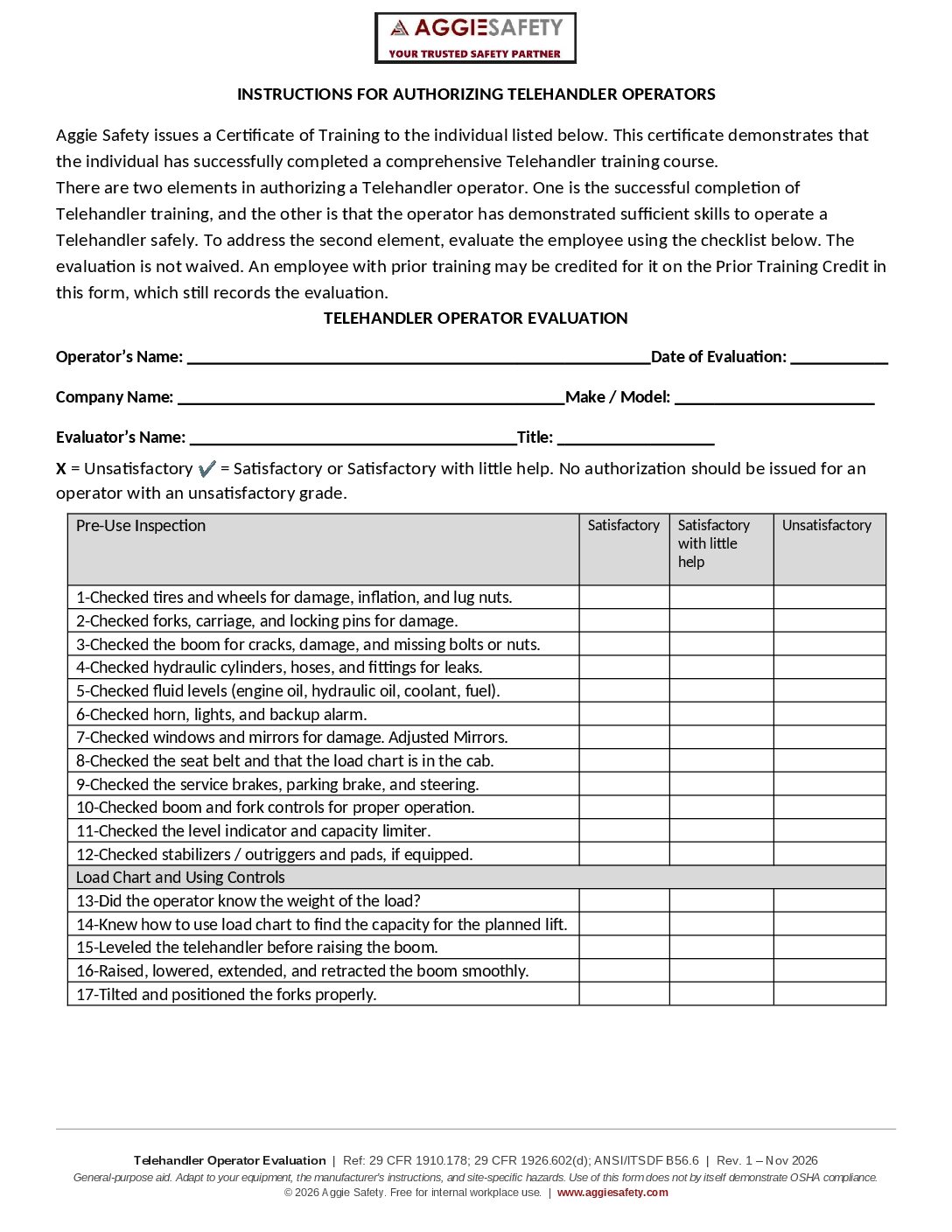
First page of the Telehandler Operator Evaluation Checklist
1 Free PDF Packet
EN / ES Online training options
Texas Houston-based support
100+ Years combined experience
Practical Tools for Your Team

Put Consistent Telehandler Records in Your Team’s Hands

No sign-up needed. Give operators, supervisors and safety staff one packet for equipment checks and hands-on evaluations.

First page of the Telehandler Operator Evaluation Checklist

Telehandler Operator Evaluation & Inspection Checklist

3 pages · Portrait PDF

Use this three-page packet to identify the operator, telehandler make/model and evaluator, record observed skills, and document Prior Training Credit and employer authorization with training/evaluation dates and signatures.

Download Free Checklist
What's Inside

What the Telehandler Checklist Covers

Pre-Use: Machine Condition

  • Tires, wheels, inflation and lug nuts
  • Forks, carriage and locking pins
  • Boom cracks, damage and missing fasteners
  • Hydraulic cylinders, hoses and fittings
  • Engine oil, hydraulic oil, coolant and fuel levels

Pre-Use: Cab & Safety

  • Horn, lights and backup alarm
  • Windows, mirrors and mirror adjustment
  • Seat belt and in-cab load chart
  • Service brakes, parking brake and steering

Pre-Use: Controls & Setup

  • Boom and fork control operation
  • Level indicator and capacity limiter
  • Stabilizers, outriggers and pads when fitted

Evaluation: Load Chart & Controls

  • Load weight and load-chart capacity for the lift
  • Machine leveling before raising the boom
  • Smooth boom raising/lowering and extension/retraction
  • Fork tilt and positioning

Evaluation: Driving Skills

  • Three-point cab entry and seat-belt use
  • Travel-path and work-area inspection
  • Travel with boom retracted and load low
  • Slow travel with smooth braking and turning
  • Reverse observation and horn use at intersections and blind spots

Evaluation: Slopes & Spotters

  • Straight travel up/down slopes without turning
  • Spotter use when the view is blocked
  • Keeping employees out of the travel path
  • Stopping immediately when instructed

Evaluation: Loading & Placement

  • Fork spacing, level entry and a centered load against the carriage, tilted back
  • Load-chart limits throughout the entire lift
  • Smooth placement, then boom retraction and lowering before travel

Evaluation: Site Safety & Parking

  • Power-line clearance for the actual work conditions
  • No loads over people or personnel under the raised boom
  • Level parking away from traffic, boom retracted/lowered and forks grounded
  • Parking brake, neutral controls, engine shutdown and key removal
  • Three-point cab exit without jumping

Documentation Included in the Packet

  • Operator, company, telehandler make/model, evaluator name/title and evaluation date
  • Observed-item ratings and Prior Training Credit with source/date and evaluator signature
  • Employer authorization with training/evaluation dates, trainer/evaluator name, and authorizing signature, title and date
  • Prior Training Credit: appropriate prior training may be credited, but the workplace evaluation is not waived. The PDF states re-evaluation is due at least every three years.

How Each Item Is Rated

✔ Satisfactory
✔ Satisfactory with little help
X Unsatisfactory

Mark each observed item. The form states that no authorization should be issued with an unsatisfactory grade; document gaps, arrange follow-up training and reassess.

A Consistent Process Across Shifts

Make Telehandler Checks Part of Your Team’s Routine

New hires, changing shifts and busy production schedules can leave gaps in records. Use a repeatable workflow that gives operations and EHS clear responsibilities.

Plan Training around Shifts

Schedule formal instruction around production needs. English and Spanish online course options help you coordinate training for a bilingual workforce.

Evaluate in Your Workplace

Evaluate hands-on skills on the actual telehandler, tasks and worksite. The PDF advises questioning the operator about hazards such as slopes, power lines or unsafe ground when those conditions are not present during the evaluation.

Keep a Complete Record

Retain the telehandler make/model, evaluation dates, evaluator signature, training records and signed employer authorization. Track the re-evaluation due date.

Close the Loop on Defects

Use your equipment inspection and defect-reporting process to flag concerns, document maintenance follow-up and inform the next operator.

Training That Fits Your Workforce

Telehandler Training for Busy, Bilingual Teams

Coordinate formal instruction around shifts with self-paced online training in English or Spanish. Pair it with equipment-specific practice, workplace evaluation and retained records; online course completion does not waive the hands-on evaluation.

  • Covers telehandler stability, load charts, ground conditions, outriggers, pre-use inspection and safe travel
  • Certificate of Completion you can print right after passing
  • Free test retakes and no time limit
  • English and Spanish course options for a bilingual workforce
FAQ

Frequently Asked Questions

Does This Checklist Replace Telehandler Training?

No. Use it alongside training and site-specific practical instruction. Prior Training Credit does not waive the workplace evaluation. A course certificate or completed form alone does not demonstrate safe operating competence or OSHA compliance.

What Does the Telehandler Packet Document?

Operator, company, make/model, evaluator name/title and evaluation date. Prior Training Credit records the prior training source/date and evaluator signature. Employer authorization includes training/evaluation dates, trainer/evaluator name and the company representative’s signature, title and date.

How Are Operator Skills Rated?

The form uses ✔ for Satisfactory or Satisfactory with little help, and X for Unsatisfactory. It states that no authorization should be issued with an unsatisfactory grade. Record gaps, arrange follow-up training and reassess.

How Often Should Operators Be Re-evaluated?

The PDF states re-evaluation is due at least every three years. Keep the completed evaluation, evaluation dates and signed employer authorization with the operator’s training records, and follow applicable refresher-training requirements.

Is the Telehandler Checklist Free to Use?

Yes. The PDF is free for internal workplace use. Adapt it to your equipment, the manufacturer’s instructions and site-specific hazards.

Can Aggie Safety Support Our Existing EHS Team?

Yes. We work alongside in-house EHS and operations teams—not instead of them. Ask about on-demand safety consulting, independent inspections, training support and specialist engineering help for your facility.

How Can We Train a Bilingual, Rotating Workforce?

Aggie Safety offers English and Spanish online telehandler courses that operators can work through around shift schedules. Arrange equipment-specific hands-on practice and workplace evaluation separately, then retain the completed records.

General-purpose aid. Adapt to your equipment, the manufacturer's instructions and site-specific hazards. Use of this form does not by itself demonstrate OSHA compliance. © 2026 Aggie Safety. Free for internal workplace use.

Aggie Safety Logo
Your safety partner in OSHA compliance and workforce protection.
  • 6001 Savoy Dr Suite #201B, Houston, TX 77036, USA
  • 8AM – 5PM Monday – Friday
© 2026 Aggie Safety | All Rights Reserved.